
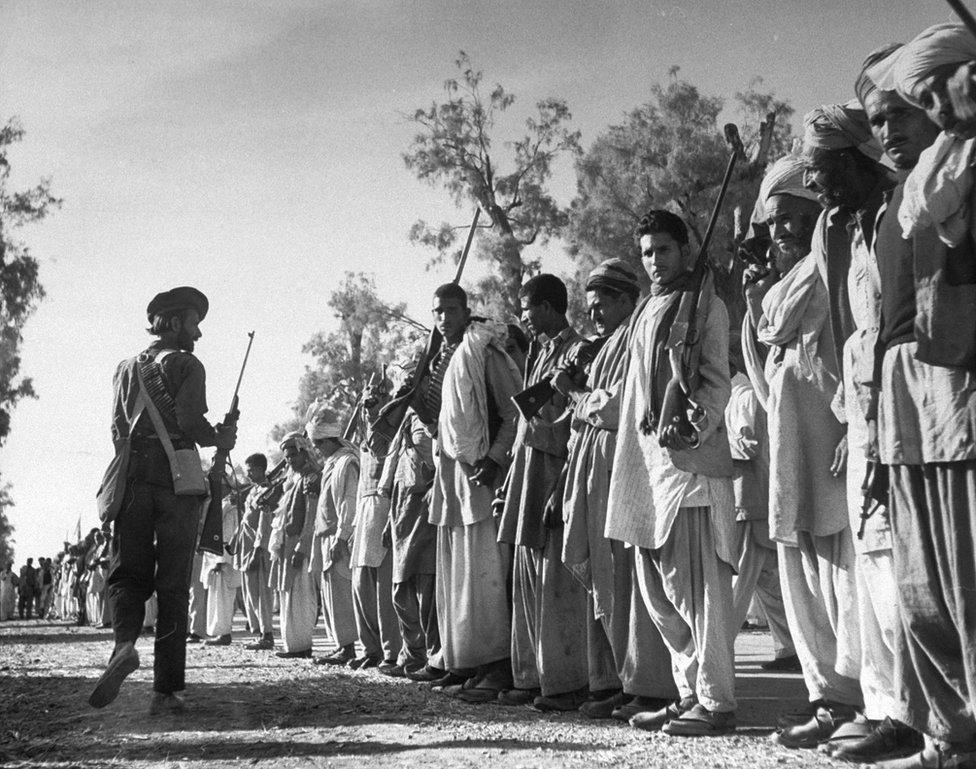
October 22, 1947, remains one of the darkest dates in the history of Jammu and Kashmir. On this day, armed tribal raiders backed by Pakistan launch
How effective is the Swat model? By Abdullah M. Adnan

The West seems stunned by the sudden turn of events in Pakistan. The Pakistani government recently negotiated a truce with The Movement for Enforcement of Shari’a (TNSM), endorsed by the local Taliban in Pakistan, to introduce shari’a-based law in the tribal Malakand area.
The Chief Minister of the Northwest Frontier Province (NWFP), Ameer Haider Khan Hoti, announced on 16 February that a peace deal between the government and the TNSM had been struck, but claimed that the law’s implementation would depend upon restoration of peace in the area.
After almost two weeks, however, the deal is in a precarious state. The TNSM chief, Maulana Sufi Muhammad, unhappy over the slow progress of the government in creating the courts, hinted in his press conference on 3 March that if the agreement was violated or obstructed in any way, he would back out.
Regardless of the end result, however, the deal still presents a model for peace in Pakistan’s troubled areas, if it is implemented with sincerity and efficiency on all sides.
NWFP’s provincial government agreed to set up shari’a-based courts in Malakand that would issue verdicts according to Islamic tenets within six months of filing a case. Hoti dismissed fears that Taliban-style courts were the ultimate goal by saying that the government would appoint judicial officers to preside over the courts and that all provisions within the agreement were in line with the constitution and basic human rights.
In negotiating such a truce, Pakistan seems to have taken its cue from British and US officials who have recently been distinguishing between “good” and “bad” Taliban in the hopes of identifying those militants that can be engaged in dialogue and those that are bent on using violence.
Those in the West that are shaking their heads in disbelief need to understand that this decision was a product of a combination of circumstances: the extension of the so-called “war on terror” to Pakistan in the form of US ground assaults and drone attacks, US demands that the Pakistani government must do more, and the arming of tribal populations calling for the implementation of shari’a-based law.
With this agreement, the Pakistani government attempted to solve all these issues in one swoop. And for the time being, the move appears to be netting positive results.
Shortly after the government negotiated a truce with the militants, life returned to normal in the Malakand region’s Swat district. People packed into markets and many schools re-opened after more than a year’s closure.
The hundreds of thousands of residents who fled the violence have slowly started returning to their homes.
Militant groups announced a 10-day ceasefire, and then extended it for an indefinite period.
Pakistan welcomed some respite from internal strife, and, in the process, has perhaps provided an example for the United States – a way out of what is now being called the “graveyard of empires” – Afghanistan, where the United States has thus far been similarly unable to defeat Al Qaeda and the Taliban through force.
While the deal elicited a mixed reaction from world powers, US Secretary of Defense Robert Gates’ response was to suggest that this agreement might serve as an example: “If there is a reconciliation, if insurgents are willing to put down their arms…Washington could accept a political agreement between the Afghan government and the Taliban militants along the lines of a truce in Pakistan.”
This philosophy could drive the US approach to winning the so-called “war on terror” in Afghanistan: instead of a troop surge, US President Barack Obama should start pulling out forces from Afghanistan as he plans to do in Iraq.
Following Pakistan’s example, the United States should use creative, non-violent strategies to engage those willing to lay down arms in order to weed out extremism. Military action, drone attacks and the like – in Pakistan as well as Afghanistan – only fan extremist tendencies.
Only time will tell if Pakistan’s deal with TNSM leads to lasting peace and stability in the area. But with the troop surge in Afghanistan under way and the United States beginning to encroach on Pakistan’s territory by way of military action within the country’s borders, an alternative strategy could be beneficial.
###
* Abdullah M. Adnan (abdullahmadnan@hotmail.com) is a researcher and political analyst based in Islamabad. This article was written for the Common Ground News Service (CGNews).
The Chief Minister of the Northwest Frontier Province (NWFP), Ameer Haider Khan Hoti, announced on 16 February that a peace deal between the government and the TNSM had been struck, but claimed that the law’s implementation would depend upon restoration of peace in the area.
After almost two weeks, however, the deal is in a precarious state. The TNSM chief, Maulana Sufi Muhammad, unhappy over the slow progress of the government in creating the courts, hinted in his press conference on 3 March that if the agreement was violated or obstructed in any way, he would back out.
Regardless of the end result, however, the deal still presents a model for peace in Pakistan’s troubled areas, if it is implemented with sincerity and efficiency on all sides.
NWFP’s provincial government agreed to set up shari’a-based courts in Malakand that would issue verdicts according to Islamic tenets within six months of filing a case. Hoti dismissed fears that Taliban-style courts were the ultimate goal by saying that the government would appoint judicial officers to preside over the courts and that all provisions within the agreement were in line with the constitution and basic human rights.
In negotiating such a truce, Pakistan seems to have taken its cue from British and US officials who have recently been distinguishing between “good” and “bad” Taliban in the hopes of identifying those militants that can be engaged in dialogue and those that are bent on using violence.
Those in the West that are shaking their heads in disbelief need to understand that this decision was a product of a combination of circumstances: the extension of the so-called “war on terror” to Pakistan in the form of US ground assaults and drone attacks, US demands that the Pakistani government must do more, and the arming of tribal populations calling for the implementation of shari’a-based law.
With this agreement, the Pakistani government attempted to solve all these issues in one swoop. And for the time being, the move appears to be netting positive results.
Shortly after the government negotiated a truce with the militants, life returned to normal in the Malakand region’s Swat district. People packed into markets and many schools re-opened after more than a year’s closure.
The hundreds of thousands of residents who fled the violence have slowly started returning to their homes.
Militant groups announced a 10-day ceasefire, and then extended it for an indefinite period.
Pakistan welcomed some respite from internal strife, and, in the process, has perhaps provided an example for the United States – a way out of what is now being called the “graveyard of empires” – Afghanistan, where the United States has thus far been similarly unable to defeat Al Qaeda and the Taliban through force.
While the deal elicited a mixed reaction from world powers, US Secretary of Defense Robert Gates’ response was to suggest that this agreement might serve as an example: “If there is a reconciliation, if insurgents are willing to put down their arms…Washington could accept a political agreement between the Afghan government and the Taliban militants along the lines of a truce in Pakistan.”
This philosophy could drive the US approach to winning the so-called “war on terror” in Afghanistan: instead of a troop surge, US President Barack Obama should start pulling out forces from Afghanistan as he plans to do in Iraq.
Following Pakistan’s example, the United States should use creative, non-violent strategies to engage those willing to lay down arms in order to weed out extremism. Military action, drone attacks and the like – in Pakistan as well as Afghanistan – only fan extremist tendencies.
Only time will tell if Pakistan’s deal with TNSM leads to lasting peace and stability in the area. But with the troop surge in Afghanistan under way and the United States beginning to encroach on Pakistan’s territory by way of military action within the country’s borders, an alternative strategy could be beneficial.
###
* Abdullah M. Adnan (abdullahmadnan@hotmail.com) is a researcher and political analyst based in Islamabad. This article was written for the Common Ground News Service (CGNews).
You May Also Like

In the developed nations of the world—such as those in Europe, the United States, and the United Kingdom—a democratic form of governmen
Evidence is “the raw data, material, testimony, or information presented to support or disprove a claim.” Proof is “the final con


PCP need your support that we may provide you better services: click on donate


"Trial of Pakistani Christian Nation" By Nazir S Bhatti
On demand of our readers, I have decided to release E-Book version of "Trial of Pakistani Christian Nation" on website of PCP which can also be viewed on website of Pakistan Christian Congress www.pakistanchristiancongress.org . You can read chapter wise by clicking tab on left handside of PDF format of E-Book.