

As wars and armed conflicts intensify, humanitarian emergencies deepen and millions are forced from their homes, multitude of crises unfold - large
Interview conducted by Manish Rai: In the present circumstances, we will retain our weapons for self-defense: PKK
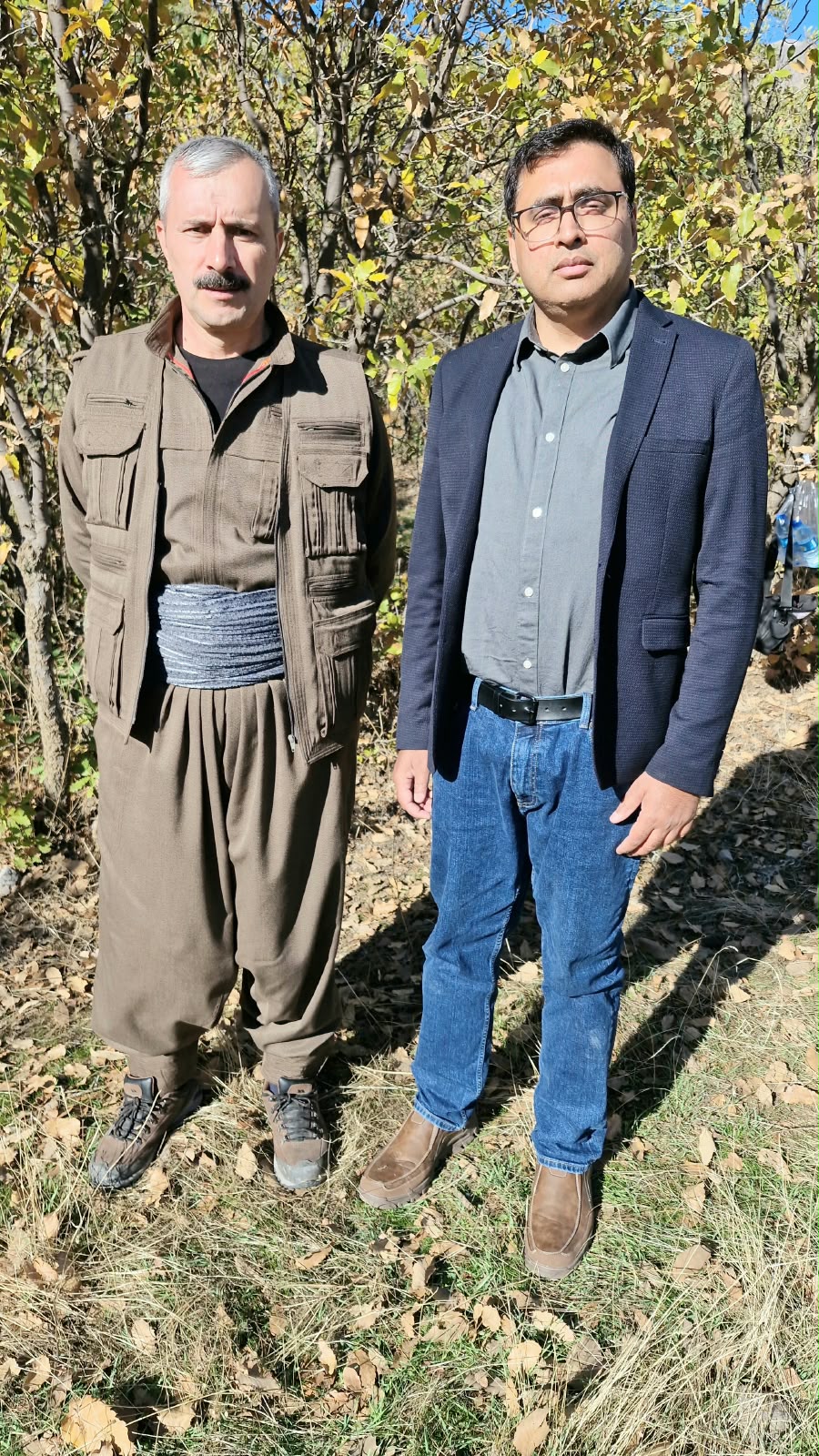
Although the 2025 PKK–Turkey peace process, also referred to as the Second Peace Process or the Second Solution Process, is not making significant progress, it is still being actively pursued, particularly by the Kurdistan Workers' Party (PKK). The process was perceived as the successor to the unsuccessful 2013–2015 PKK–Turkey peace process. To acquire a thorough understanding of the PKK's future political roadmap and its dedication to the peace process, Manish Rai, a geopolitical analyst, visited the Qandil Mountains, which have been the de facto political and military headquarters of the PKK since the early 1990s. Mr. Zagros Hiwa, the senior leader and spokesperson of the PKK, was interviewed by Manish Rai in the depths of the Qandil about various issues related to the peace process. The following is a comprehensive interview with Mr. Hiwa.
Question 1: You have implemented numerous unilateral measures as part of the peace process, such as the withdrawal of military units from urban centers in Turkey, including Istanbul and Ankara, and the symbolic burning of weapons. However, Turkey has not reciprocated and has not implemented any confidence-building measures. Despite Turkey's approach, are you still dedicated to the peace process?
Answer: Indeed, we remain dedicated to the peace process. Our pursuit of the peace process has not begun recently, either. In 1988, our dedication to the peace process was initiated when the Turkish government was urged to engage in negotiations with the movement by our leader, Apo. At that time, he also stated that the war had fulfilled its purpose and that it was now time for a political solution. Between 1988 and the present, we have implemented nine unilateral ceasefires. These are all indications and manifestations of our dedication to a democratic resolution of the Kurdish issue and to peace. It is not, in my opinion, a metric for the burdens that the Turkish government imposes on us. We are genuinely of the opinion that the Kurdish issue cannot be resolved through military means. A political solution to the Kurdish question is necessary. It must be addressed within the context of the region's democratization, with a particular emphasis on the democratization of Iran, Turkey, Syria, and Iraq. However, these states were unable to democratize themselves, which is why the Kurds require some form of self-defense. Therefore, our military force has consistently existed for the purpose of self-defense. At present, we maintain the option of maintaining a military presence in these locations solely for self-defense, rather than launching an attack on other states. The Kurdish question is distinct from any other conflict in the world. There is something peculiar about it. I am referring to a nation or a people that is divided among four countries. And in all of those countries, the Kurdish people have faced sheer denial, pure denial like no other people, and have been neglected and denied for 100 years. Therefore, to prevent annihilation, the Kurds must implement some form of self-defense. As a demonstration of our sincere conviction for peace, since 1993, when President Jalal Talabani served as an intermediary between the late President Turgut Özal and our leader, Leader Abdullah Öcalan, we have been pursuing this goal. As previously stated, these unilateral actions are a clear demonstration of our benevolence. As you are aware, the PKK was founded in the late 1970s. Back then, there was Real Socialism, including the Chinese socialist bloc, Soviet socialism, and the Pact of Warsaw. I mean, it was influenced by the socialist practices we experienced and the Marxist-Leninist ideology. However, the collapse of that particular form of socialism occurred following the decline of the Soviet Union. Consequently, we were compelled to reconsider our approach to the concept of socialism. An approach that had to be contrary to the methodology implemented in the Soviet Union was another process. Their approach was incorrect; that’s why they collapsed. This is the reason why the Soviet Union collapsed after 70 years. That’s because their approach methodology was incorrect.
I acknowledge that socialism is a valid ideology; however, the methodology, concepts, and notions that underlined the Soviet Union's practice were flawed. This is the reason it collapsed. Additionally, their interpretation of society, their approach to history, their analysis of social classes, and their descriptions of these classes were all inaccurate. This is the reason they collapsed. Therefore, Leader Apo re-evaluated the socialist practice of the past 300 years and devised a novel approach to the pursuit of freedom. And we have not abandoned socialism; rather, we have abandoned those concepts and methodologies of socialism that are incompatible with historical and social realities. We believe that society is an indispensable component of human existence. However, this society should not be governed solely by the state or authority; society can self-govern itself. In that case, socialism ought to be democratic. In other words, if socialism exists, it must be accompanied by democracy. That is the primary renovation that we have implemented. I mean, according to this concept, democracy is essential for socialism. Stalinism was not socialist, after all. Finally, they paved the way for capitalism. I mean, it was not democratic. We believe it is only socialist if it is democratic.
Therefore, our endeavour will be legal from this point forward, and it will be to ensure that the Kurds' rights are inscribed in the Turkish constitution and the legal system. This necessitates an effort, as the Turkish state is not going to provide you with anything on its own.
Question 2- You suggest that you have now exclusively chosen democratic struggle and have ceased to engage in armed struggle. Would you be willing to surrender your armaments to the Turkish government and disarm?
Answer: Why should we disarm now? Has Turkey implemented any legal amendments to its constitution? The term "Kurd" has not even been mentioned in the Turkish parliament to date. They are saying that Turkey should be freed from terror. However, they have not explicitly stated that they will resolve the Kurdish issue. Therefore, Turkey must implement legal and constitutional measures to acknowledge the political, cultural, and identity rights of the Kurds. The guerrillas are not willing to relinquish their weapons. You are aware that the issue is not one of surrender. The objective is to advance toward a peaceful initiative. I am referring to a peaceful initiative, not a surrender. Turkey, of course, is interested in defining the process exclusively in terms of disarmament, disintegration, and surrender, and it is committed to the complete eradication of the PKK. But we have been grappling with this condition for over 50 years; we are seasoned. Our organization is aware that Turkey has yet to abandon its policy of denial regarding the Kurds. Therefore, there will be no complete disarmament or handing over of weapons until this policy is altered. The Kurdish rights must be recognized through legal amendments before we can consider disarmament. Additionally. The freedom of our leader, Apo (Abdullah Ocalan), is our primary parameter. He should only be responsible for coordinating this process and should be freed physically. He should be permitted to interact with individuals, the press, and foreign diplomats. I am referring to the fact that the peace process cannot be achieved solely through indirect messages from the Imrali prison.
However, those events have not transpired; Leader Apo is not liberated. He remains in prison. He has not been visited by the press. Politicians are prohibited from visiting him. Our movement's members are unable to visit him. Therefore, the guerrillas will only disarm when the procedure is overseen by leader Apo. Otherwise, it is impossible for the guerrillas to disarm because he has initiated a process. He is required to collaborate with the guerrillas, engage in discussions with them, and elucidate to them that this is our strategy. He is our leader and top commander; you are aware that we will not take any action unless he personally coordinates it.
Question 3- You are discussing the rights of the Kurds in Turkey and the necessity for the Turkish government to modify its policy. However, as we are all aware, the PKK has served as an inspiration for the Kurdish movement in the entire region, including different parts of Kurdistan, i.e., Bashur, Bakur, Rojava, and Rojhelat. Would you like Turkey to modify its policy, particularly in Rojava, as it has also occupied a substantial area there? Do you want Turkey to also withdraw from Rojava?
Answer: Turkey's political policies and mindset toward the Kurds may be altered if the Kurds are not perceived as an existential challenge to the territorial integrity and sovereignty of the Turkish state. Then, Turkey will cease to perceive Kurdish gains in Rojava, Bashur, and Rojhelat as a threat to its territorial integrity. If Turkey changes its mentality and policies toward the Kurds, then it will be able to treat them well, accept them, and recognize them as free and equal citizens of Turkey, who enjoy their own national identity and political and cultural rights. The Kurds will be treated as an asset, not a threat. However, Turkey has yet to alter its outdated views on the Kurds. What is the mechanism by which this transformation in Turkey's thought process will occur? It is not through Turkey's goodwill that this transformation will occur; rather, it is through the Kurdish and democratic forces' struggle. We must actively work to change the Turkish state's mindset instead of passively waiting for them to recognize the Kurds and abandon their anti-Kurdish and Kurdish-phobic attitudes.
Question 4- Would you like to convey any message to other ideologically aligned groups operating in other regions of Kurdistan?
Answer: Leader Apo has established certain principles and tenets. You are aware that certain individuals in other regions of Kurdistan have embraced those principles. However, the manner in which it is implemented is entirely contingent upon the actual circumstances. It is impossible to impose a single formula on all regions of Kurdistan. Greater Kurdistan is characterized by distinct political, social, cultural, realpolitik, diplomatic, and military conditions in each region. For instance, a solution paradigm that is practically applicable in Turkey cannot be imposed on Rohjelat (Iran) or Rojava (Syria). Even one village is distinct from the next. We are discussing four primary countries in the Middle East. The historical, political, cultural, social, and economic backgrounds of each country are significantly distinct. Therefore, the initiatives in other regions of Kurdistan that have been motivated by the principles we adhere to are capable and autonomous in their decision-making. Therefore, we refrain from providing them with any advice.
Question 5- Turkey has stated that they can consider giving amnesty to the guerrillas, but they can’t offer any form of immunity to PKK commanders. What do you think about why Turkey is pursuing this dual policy? Could Turkey be attempting to fracture the PKK's unity?
Answer: The Turkish state wants to liquidate and eliminate our movement. They are unwilling to resolve the Kurdish issue. How is it possible for commanders to remain in Qandil while guerrillas travel to Turkey? Militarily, is it not feasible? The ‘framework law’ should be comprehensive if it is to be implemented. It should include all individuals, including the movement's leaders, the leader Apo, and all guerrillas. All cadres should receive the same treatment, regardless of their position. The mentality underlying this kind of dual policy is flawed. Amnesty is not what the guerrillas want. They are, in fact, interested in engaging in democratic politics. We haven't committed a crime for us to seek amnesty. We are the freedom fighters for our people. And from this point forward, we will engage in a struggle. We do not desire amnesty from any individual or entity. Therefore, we have declared that we will not pose a military threat to your country. However, we aspire to conduct democratic politics without the use of arms. However, if they push such rhetoric, like "They will return home and some form of amnesty will be granted to them” I assure you there will be no repentance. I mean, no guerrilla experiences remorse or anticipates forgiveness from the Turkish government. Our expectations are not individual; they are collective, such as the recognition of the Kurds' legitimate rights.
Question 6- Many critics of your organization have contended that your founder leader, Abdullah Öcalan, also known as Leader Apo, has been imprisoned since 1999 and has not engaged with society for the past 27 years. So, it's unclear how he can advocate for the PKK's disarmament and disintegration when he doesn't know the ground realities.
Answer: Has he not demonstrated his leadership abilities through the process he has initiated? I responded to that enquiry by posing an additional query. Certainly, these are valid concerns. I am referring to the fact that leader Apo has been in solitary confinement for 27 or 28 years. I mean, he has lost touch with the real world, as he is isolated from society and the movement. These are all valid concerns. Throughout the past many years, we have continued to raise this matter. However, there are certain unique characteristics of the Kurds and their leader, Abdullah Ocalan. He was the one who founded this movement, and he personally trained and educated the cadres. You are aware that the arduous labour of Leader Apo is the reason for all of this movement. In other words, the PKK has been significantly influenced by his political beliefs, strategy, and vision. In summary, he possesses a proficient understanding of politics and society. He was able to have such a significant impact on Middle East politics and Kurdish politics because he conducted a thorough analysis of society, politics in the region, culture, and the global landscape. Additionally, leader Apo does not make any decisions independently. He gets in contact with the movement in some form, and all decisions are made collectively. He considers the movement's perspective before making any decisions, including those made in Imrali prison. Prior to issuing the call for disarmament in February 2025, he solicited the opinions of the cadres. Of course, he solicited the opinions of the cadres. He communicated with us via correspondence and teleconference. To verify that it is Apo, the leader, who is conducting the call, we implemented teleconferencing and other methods.
Question 7- Are all the groups within the organisation in agreement regarding the peace process and its implementation?
Answer: If leader Apo can directly assume responsibility for leading this process toward a democratic solution, and as long as he is able to practically do so, all members of the organization will be in agreement. He holds that authority, and there is no likelihood of any type of internal conflict within the organization. As long as he is able to assume direct responsibility for the process and is released, I am referring to his physical release from incarceration, which will allow him to work and live more freely. All members of the organization will be in agreement. If he is not released, the political landscape may evolve independently. However, the organization will be in consensus as long as he is in charge, essentially in a free state.
Question 8- Many observers of the region believe that Turkey has become more oppressive and undemocratic in recent years. However, what is the silver lining that you saw in initiating this reconciliation process now?
Answer: Indeed, the Turkish government has become increasingly oppressive. There is a significant increase in corruption, as well as higher pressure on journalists, politicians, and activists. Turkey's inflation rate is elevated. But if Turkey had been a democratic state and President Erdogan had been a democratically inclined leader, there would have been no necessity for peace. You do not establish peace with a democratic state. You establish peace in order to transform an undemocratic state into a democratic one. I mean, if Turkey had been democratic, there would have been no necessity for such a conflict. The Kurdish question cannot be resolved in the absence of Turkey's democratic transformation. However, we believe that the Kurdish issue should be resolved in conjunction with democratization; they should be implemented simultaneously. As a gesture of goodwill, our organization has unilaterally implemented this measure. We have adopted a new strategy for the struggle and have not abandoned it.
Question 9- What is the political ideology of democratic confederalism, and you reject the notion of the nation-state? However, do you believe that in the present day, small community-based units are incapable of self-defense and necessitate a nation-state to provide protection?
Answer: It is not correct to infer that communities are inherently feeble. Communities are capable of self-defense only when they are effectively organized. That defense does not necessarily entail military defense. In the world, there have been numerous instances of individuals revolting, uprising non-violently, and without military force, and asserting their rights. These serve as commendable examples for our movement as well. In the event that societies are well-organized, this society is not required to face off against the state. Our objective is to strengthen independence and reduce dependence on the state. Local governance should be prioritized in the majority of cases, and we are not opposed to the notion of a nation-state. An individual may reside in any democratic nation if their identity as a people is acknowledged, their rights are respected, and the rights of women are acknowledged. We are not opposed to the Kurdish nation-state; however, we are committed to the empowerment of society. A few Kurdish organizations operate in support of a nation-state; we are not opposed to them.
Question 10- Do you have a specific timeline for the peace process initiative?
Answer: We do not possess a timeline. According to us, the sooner, the better. It is imperative that these matters be addressed without delay. No, it is not as simple as that: “if you fail to comply, we will resume fighting.” These measures have been implemented due to the evolving nature of the region. There are numerous intervening factors in the region. In Kurdistan, there are not only the PKK but also other Kurdish parties. There are international forces; there are four states. Each of them has an impact on Kurdistan. Therefore, Turkey ought to expedite its efforts to achieve peace.
Question 11- Could we infer that this is a permanent ceasefire from your perspective?
Answer: Yes, it’s a permanent ceasefire. Unless there is an attack on us, we will not use guns. We use weapons only to defend ourselves.
You May Also Like
Jammu and Kashmir is facing a serious challenge in the form of drug addiction, which is destroying the lives of thousands of young people and creat
If an ordinary person lives in delusional world it doesn’t matter to anyone else but when the POTUS lives in a delusional world then it shoul


PCP need your support that we may provide you better services: click on donate


"Trial of Pakistani Christian Nation" By Nazir S Bhatti
On demand of our readers, I have decided to release E-Book version of "Trial of Pakistani Christian Nation" on website of PCP which can also be viewed on website of Pakistan Christian Congress www.pakistanchristiancongress.org . You can read chapter wise by clicking tab on left handside of PDF format of E-Book.