
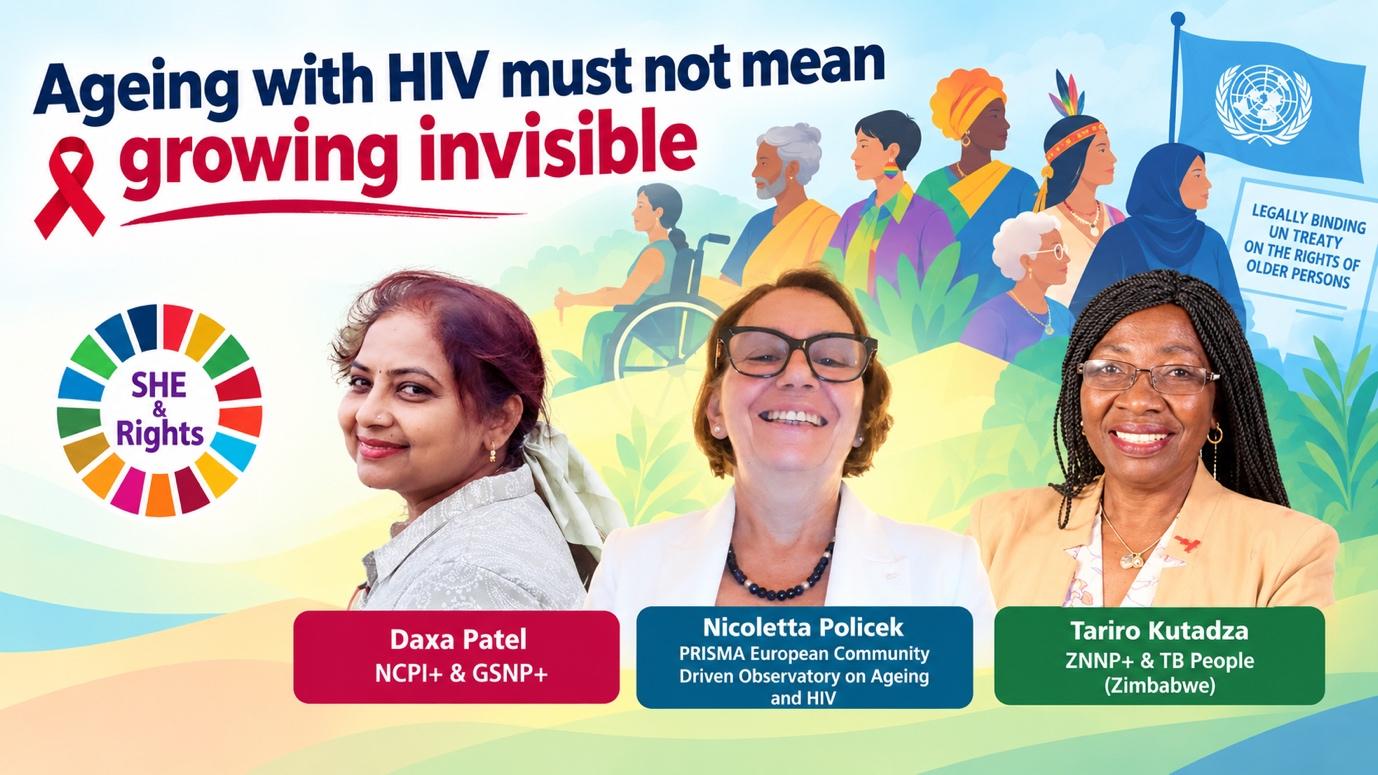
As long-term HIV survivors face stigma, fragmented healthcare and financial insecurity, community leaders call for a legally binding UN treat
Communities must be financed, not just celebrated, says UNAIDS' Eamonn Murphy ahead of AIDS 2026. By SHOBHA SHUKLA
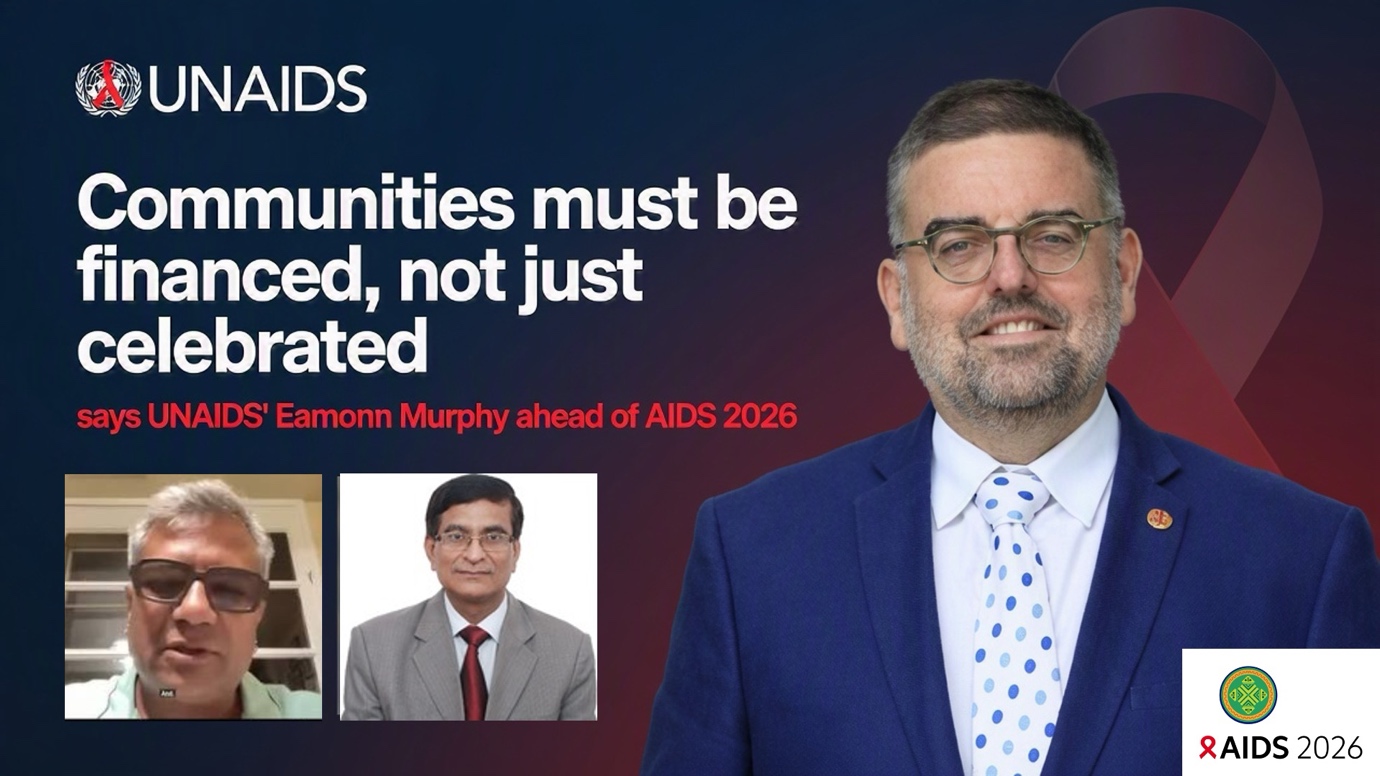
As the global HIV response faces shrinking funding, increasing pressure on civil society, and growing attacks on human rights and gender equality, UNAIDS' Eamonn Murphy has called for communities to remain at the centre of the fight against HIV - not only in principle but also in policy, financing and governance.
His powerful message captured both the urgency and the opportunity facing the global HIV response as governments, civil society, researchers and community leaders prepare for the world's largest AIDS conference this year (26th International AIDS Conference or AIDS 2026 in Rio de Janeiro, Brazil).
Eamonn Murphy leads UNAIDS as Regional Director for Asia Pacific, Eastern Europe and Central Asia.
Delivering the keynote address at AIDS 2026 Affiliated Independent Event hosted by GNP+, NCPI+, CNS and partners, Murphy congratulated governments, communities and technical partners on securing the new United Nations Political Declaration on HIV/AIDS, adopted last month at the UN General Assembly High-Level Meeting (UNHLM) on HIV/AIDS.
Describing the declaration as "a joint win," Murphy stressed that it was achieved during an exceptionally difficult political period, making the consensus all the more significant. It is important to note that such Political Declarations have conventionally been adopted with consensus by all governments globally. But since last year, US-led forces have upped their attacks against health and gender rights, said Manoj Pardeshi of National Coalition of People living with HIV in India (NCPI+). Out of 194 UN member countries, 149 voted in favour, with US and few others voting against it (and the rest abstained or were absent). Pardeshi chaired an important session at AIDS 2026 Affiliated Independent Event: Naresh Yadav Memorial Leadership Summit.
Communities at the heart of the HIV response
UNAIDS' Murphy reminded participants that community leadership was never a gift bestowed by policymakers. Inclusion of communities was earned through decades of activism, courage, lived experience and relentless advocacy.
According to Murphy, community leadership is indispensable if the world hopes to achieve the global HIV targets by 2030.
Community-led health service delivery model is the lynchpin to reach the unreached
People living with HIV, key populations and community organisations have repeatedly shown that they reach those whom formal health systems often fail to reach. They build trust where stigma persists, support treatment adherence where health systems are overstretched, and defend human rights where discrimination remains entrenched.
For Murphy, this is why communities are no longer viewed merely as beneficiaries of HIV programmes, but they are recognised as equal partners in designing, delivering, monitoring and governing the HIV response.
The internationally endorsed 95-95-95 targets - which seek to ensure that 95% of people living with HIV know their HIV status, 95% of those diagnosed with HIV receive antiretroviral therapy, and 95% of those on treatment achieve viral suppression - cannot be achieved without trusted community networks, said Murphy.
Scientific breakthroughs alone will not achieve the global HIV targets. Murphy noted that the globally agreed 95-95-95 targets depend on much more than medicines. They require people to trust services enough to seek HIV testing, begin treatment quickly, remain in care and achieve viral suppression.
HIV testing, rapid linkage to treatment, long-term adherence, viral load literacy and widespread understanding of "Undetectable equals Untransmittable" (U=U) all depend heavily on trusted relationships built by community-led organisations, he said. U=U is critically important because when viral load of persons with HIV is undetectable, the virus is also untransmittable - or in other words, HIV treatment works as prevention.
Do not forget 30-80-60 targets for 2030
Murphy also highlighted the 30-80-60 targets, which explicitly recognise community leadership. By 2030, community-led organisations are expected to provide 30% of HIV testing and treatment support services, 80% of HIV prevention services for key populations, and 60% of programmes addressing legal and social barriers.
These targets are more than aspirations—they are accountability tools that communities can use to measure government performance, said Murphy.
"We must not forget 30-80-60 targets, as these are very critical if we are to end AIDS in the next 54 months (by 2030)," said Dr Bharat Bhushan Rewari, who has earlier led the lifesaving antiretroviral therapy programme at Government of India's National AIDS Control Organisation (NACO). Dr Rewari also formerly led the WHO as South-East Asia Regional Advisor for HIV, hepatitis and STIs.
Political commitments require financial commitments
While acknowledging that many governments praise community organisations during international meetings, Murphy warned that recognition alone will not sustain HIV programmes.
"Community leadership must be financed - not simply applauded," he said.
He cautioned that several countries are transitioning towards domestic financing at a time when international HIV assistance is declining. Unless national budgets explicitly include community-led services, many of the programmes responsible for reaching key populations could disappear.
"A service without a budget line is a service at risk," Murphy observed.
He pointed out that treatment services and diagnostics are often protected within government health budgets, while prevention programmes, rights-based interventions and community outreach continue to rely disproportionately on external donor support.
Such an imbalance, he warned, threatens decades of progress.
He argued that governments should institutionalise community-led responses through dedicated budget allocations, social contracting mechanisms and fully costed community service packages.
Communities must also participate in setting national priorities from the beginning - not simply be consulted after financial decisions have already been made.
Success stories offer hope
Despite the challenges, Murphy highlighted encouraging examples from Asia.
Cambodia's recent achievement of the 95-95-95 targets demonstrates what determined national leadership and community partnership can accomplish.
Thailand's successful integration of community-based HIV services into the national health system similarly illustrates how governments can institutionalise trusted community-led approaches while improving access to care.
These experiences show that sustainable progress depends on genuine partnerships between governments, health systems and communities. These success stories also
Innovation must strengthen - not replace - communities
Murphy welcomed scientific advances including HIV self-testing, long-acting HIV prevention technologies, differentiated treatment models and expanded viral load monitoring.
However, he cautioned that innovation cannot replace the trust built by community organisations.
Peer support, community mobilisation, demand generation and community-led monitoring remain essential if technological advances are to achieve their full public health impact.
When a bacteria (TB) and virus (HIV) can work together then why cannot we?
Integration, he added, should also improve collaboration between HIV and tuberculosis services.
"We will not end AIDS while preventable TB deaths continue," Murphy said.
A decisive moment
As the world moves towards AIDS 2026, Murphy's message resonates far beyond conference halls: communities should not merely be recognised for the role they have played - they must be trusted, empowered and adequately financed to lead the next phase of the global HIV response.
Only then can the commitments made in international declarations become lasting improvements in people's lives.
He called on governments to translate the newly adopted Political Declaration into funded national action plans, while urging international donors not to retreat precisely when communities are being asked to deliver more with fewer resources.
"The declaration is in place. The science exists. Communities have demonstrated their leadership," Murphy said.
"What we need now is political will that matches our ambition - with adequate resources, protection of human rights and genuine partnership with communities."
His message was clear: ending AIDS will require far more than medical innovations. It will demand sustained political commitment, investment in community leadership and accountability at every level of the global HIV response.
(Shobha Shukla is a feminist, health and development justice advocate, and an award-winning founding Managing Editor and Executive Director of CNS (Citizen News Service). She serves as Chairperson of Global AMR Media Alliance (GAMA), Host and Coordinator of SHE & Rights (Sexual Health with Equity & Rights), President of Asia Pacific Media Alliance for Health, Gender and Development Justice (APCAT Media), and founder leader of DJOP (Development Justice for Older Persons) initiative. She was also the Lead Discussant for SDG-3 at United Nations inter-governmental High Level Political Forum 2025. GAMA , led by her, received the AMR One Health Emerging Leaders and Outstanding Talents Award at UN High Level Ministerial Conference on AMR 2024. Follow her on X @shobha1shukla or read her writings here www.bit.ly/ShobhaShukla)
His powerful message captured both the urgency and the opportunity facing the global HIV response as governments, civil society, researchers and community leaders prepare for the world's largest AIDS conference this year (26th International AIDS Conference or AIDS 2026 in Rio de Janeiro, Brazil).
Eamonn Murphy leads UNAIDS as Regional Director for Asia Pacific, Eastern Europe and Central Asia.
Delivering the keynote address at AIDS 2026 Affiliated Independent Event hosted by GNP+, NCPI+, CNS and partners, Murphy congratulated governments, communities and technical partners on securing the new United Nations Political Declaration on HIV/AIDS, adopted last month at the UN General Assembly High-Level Meeting (UNHLM) on HIV/AIDS.
Describing the declaration as "a joint win," Murphy stressed that it was achieved during an exceptionally difficult political period, making the consensus all the more significant. It is important to note that such Political Declarations have conventionally been adopted with consensus by all governments globally. But since last year, US-led forces have upped their attacks against health and gender rights, said Manoj Pardeshi of National Coalition of People living with HIV in India (NCPI+). Out of 194 UN member countries, 149 voted in favour, with US and few others voting against it (and the rest abstained or were absent). Pardeshi chaired an important session at AIDS 2026 Affiliated Independent Event: Naresh Yadav Memorial Leadership Summit.
Communities at the heart of the HIV response
UNAIDS' Murphy reminded participants that community leadership was never a gift bestowed by policymakers. Inclusion of communities was earned through decades of activism, courage, lived experience and relentless advocacy.
According to Murphy, community leadership is indispensable if the world hopes to achieve the global HIV targets by 2030.
Community-led health service delivery model is the lynchpin to reach the unreached
People living with HIV, key populations and community organisations have repeatedly shown that they reach those whom formal health systems often fail to reach. They build trust where stigma persists, support treatment adherence where health systems are overstretched, and defend human rights where discrimination remains entrenched.
For Murphy, this is why communities are no longer viewed merely as beneficiaries of HIV programmes, but they are recognised as equal partners in designing, delivering, monitoring and governing the HIV response.
The internationally endorsed 95-95-95 targets - which seek to ensure that 95% of people living with HIV know their HIV status, 95% of those diagnosed with HIV receive antiretroviral therapy, and 95% of those on treatment achieve viral suppression - cannot be achieved without trusted community networks, said Murphy.
Scientific breakthroughs alone will not achieve the global HIV targets. Murphy noted that the globally agreed 95-95-95 targets depend on much more than medicines. They require people to trust services enough to seek HIV testing, begin treatment quickly, remain in care and achieve viral suppression.
HIV testing, rapid linkage to treatment, long-term adherence, viral load literacy and widespread understanding of "Undetectable equals Untransmittable" (U=U) all depend heavily on trusted relationships built by community-led organisations, he said. U=U is critically important because when viral load of persons with HIV is undetectable, the virus is also untransmittable - or in other words, HIV treatment works as prevention.
Do not forget 30-80-60 targets for 2030
Murphy also highlighted the 30-80-60 targets, which explicitly recognise community leadership. By 2030, community-led organisations are expected to provide 30% of HIV testing and treatment support services, 80% of HIV prevention services for key populations, and 60% of programmes addressing legal and social barriers.
These targets are more than aspirations—they are accountability tools that communities can use to measure government performance, said Murphy.
"We must not forget 30-80-60 targets, as these are very critical if we are to end AIDS in the next 54 months (by 2030)," said Dr Bharat Bhushan Rewari, who has earlier led the lifesaving antiretroviral therapy programme at Government of India's National AIDS Control Organisation (NACO). Dr Rewari also formerly led the WHO as South-East Asia Regional Advisor for HIV, hepatitis and STIs.
Political commitments require financial commitments
While acknowledging that many governments praise community organisations during international meetings, Murphy warned that recognition alone will not sustain HIV programmes.
"Community leadership must be financed - not simply applauded," he said.
He cautioned that several countries are transitioning towards domestic financing at a time when international HIV assistance is declining. Unless national budgets explicitly include community-led services, many of the programmes responsible for reaching key populations could disappear.
"A service without a budget line is a service at risk," Murphy observed.
He pointed out that treatment services and diagnostics are often protected within government health budgets, while prevention programmes, rights-based interventions and community outreach continue to rely disproportionately on external donor support.
Such an imbalance, he warned, threatens decades of progress.
He argued that governments should institutionalise community-led responses through dedicated budget allocations, social contracting mechanisms and fully costed community service packages.
Communities must also participate in setting national priorities from the beginning - not simply be consulted after financial decisions have already been made.
Success stories offer hope
Despite the challenges, Murphy highlighted encouraging examples from Asia.
Cambodia's recent achievement of the 95-95-95 targets demonstrates what determined national leadership and community partnership can accomplish.
Thailand's successful integration of community-based HIV services into the national health system similarly illustrates how governments can institutionalise trusted community-led approaches while improving access to care.
These experiences show that sustainable progress depends on genuine partnerships between governments, health systems and communities. These success stories also
Innovation must strengthen - not replace - communities
Murphy welcomed scientific advances including HIV self-testing, long-acting HIV prevention technologies, differentiated treatment models and expanded viral load monitoring.
However, he cautioned that innovation cannot replace the trust built by community organisations.
Peer support, community mobilisation, demand generation and community-led monitoring remain essential if technological advances are to achieve their full public health impact.
When a bacteria (TB) and virus (HIV) can work together then why cannot we?
Integration, he added, should also improve collaboration between HIV and tuberculosis services.
"We will not end AIDS while preventable TB deaths continue," Murphy said.
A decisive moment
As the world moves towards AIDS 2026, Murphy's message resonates far beyond conference halls: communities should not merely be recognised for the role they have played - they must be trusted, empowered and adequately financed to lead the next phase of the global HIV response.
Only then can the commitments made in international declarations become lasting improvements in people's lives.
He called on governments to translate the newly adopted Political Declaration into funded national action plans, while urging international donors not to retreat precisely when communities are being asked to deliver more with fewer resources.
"The declaration is in place. The science exists. Communities have demonstrated their leadership," Murphy said.
"What we need now is political will that matches our ambition - with adequate resources, protection of human rights and genuine partnership with communities."
His message was clear: ending AIDS will require far more than medical innovations. It will demand sustained political commitment, investment in community leadership and accountability at every level of the global HIV response.
(Shobha Shukla is a feminist, health and development justice advocate, and an award-winning founding Managing Editor and Executive Director of CNS (Citizen News Service). She serves as Chairperson of Global AMR Media Alliance (GAMA), Host and Coordinator of SHE & Rights (Sexual Health with Equity & Rights), President of Asia Pacific Media Alliance for Health, Gender and Development Justice (APCAT Media), and founder leader of DJOP (Development Justice for Older Persons) initiative. She was also the Lead Discussant for SDG-3 at United Nations inter-governmental High Level Political Forum 2025. GAMA , led by her, received the AMR One Health Emerging Leaders and Outstanding Talents Award at UN High Level Ministerial Conference on AMR 2024. Follow her on X @shobha1shukla or read her writings here www.bit.ly/ShobhaShukla)
You May Also Like

Every year on 26 October, Accession Day marks a historic moment in Jammu and Kashmir’s history. In 1947, Maharaja Hari Singh signed the Instr
The dispute over Jammu and Kashmir remains unresolved nearly eight decades after the events of October 1947. Although the Government of India maint


PCP need your support that we may provide you better services: click on donate


"Trial of Pakistani Christian Nation" By Nazir S Bhatti
On demand of our readers, I have decided to release E-Book version of "Trial of Pakistani Christian Nation" on website of PCP which can also be viewed on website of Pakistan Christian Congress www.pakistanchristiancongress.org . You can read chapter wise by clicking tab on left handside of PDF format of E-Book.