

As long-term HIV survivors face stigma, fragmented healthcare and financial insecurity, community leaders call for a legally binding UN treat
Thirty-Nine Days of Fire: The Tactical Triumph and Strategic Uncertainty of Operation Epic Fury. By Gregg Roman
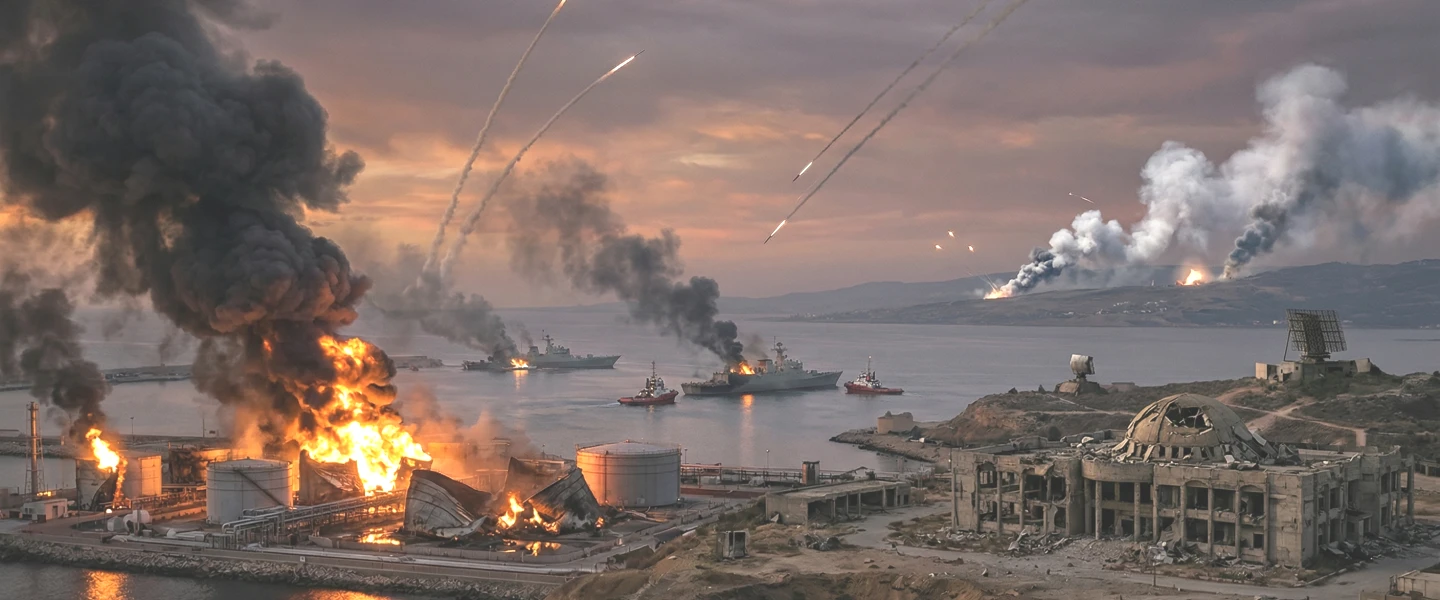
In the aftermath of a devastating thirty-nine-day U.S.-Israeli campaign that severely degraded Iran's nuclear program and eliminated its leadership , the world faces a fragile two-week ceasefire. While the immediate tactical results of Operation Epic Fury were historic , the lack of a defined political architecture for the region leaves the ultimate strategic victory in question.
The direct U.S.-Israeli strikes on Iran proper have paused. The Strait of Hormuz has been opened for a two-week window. Negotiations in Islamabad are scheduled to begin April 10. The question is not whether the coalition won the war. The question is whether “won” describes anything that has actually happened.
The direct U.S.-Israeli strikes on Iran proper have paused. The Strait of Hormuz has been opened for a two-week window. Negotiations in Islamabad are scheduled to begin April 10. The question is not whether the coalition won the war. The question is whether “won” describes anything that has actually happened.
The war came on a Saturday. It came with B-2 stealth bombers lifting off from Whiteman Air Force Base in Missouri and refueling twice over the Atlantic. It came with Israeli Air Force F-35s already loitering in Iranian airspace before Tehran’s air defense operators understood what was happening. It came, most consequentially, with a precision munition that killed Supreme Leader Ayatollah Ali Khamenei in his residential compound, his daughter and son-in-law and grandchild beside him. CBS reported approximately forty senior officials dead within the first minute. Within thirty-nine days, the combined U.S.-Israeli campaign designated Operation Epic Fury would strike more than eleven thousand military targets, sink the better part of a navy, degrade the nuclear program by sixty to eighty percent, close the Strait of Hormuz, trigger the worst global energy crisis in half a century, kill at least thirteen American service members and wound 365 more, and produce an Iranian civilian death toll that ranges, depending on whose figures one credits, from two thousand to more than seven thousand.
Then it stopped. Or rather, it partially stopped, which in the Middle East amounts to the same thing as not stopping at all. Late on April 7, President Trump announced a two-week ceasefire, calling it a “great day for world peace” and a “complete and total victory.” Iran’s Supreme National Security Council and Foreign Minister Abbas Araghchi immediately declared that the United States had “surrendered.” Netanyahu stated the ceasefire does not include Lebanon. Pakistan’s Prime Minister Shehbaz Sharif, whose country brokered the deal, stated it applies “everywhere, including in Lebanon.” Oil plunged fifteen percent in minutes. By the morning of April 8, Israeli aircraft were conducting repeated strikes across southern Lebanon (Tyre, Shabriha, Jamijmeh, Mansouri, the Dahieh suburbs of Beirut), issuing fresh evacuation warnings to residents north of the Litani River. At 2:25 PM that afternoon, the IDF Spokesperson’s Office announced what it called “the largest coordinated strike across Lebanon since the start of Operation Roaring Lion,” hitting more than one hundred Hezbollah command centers and military sites in Beirut, the Beqaa Valley, and southern Lebanon within ten minutes, targeting intelligence headquarters, firepower arrays, naval infrastructure, Radwan Force assets, and the elite Aerial (127) unit. Reports emerged of renewed Iranian attacks on the UAE and Kuwait. Explosions were reported at Iranian oil facilities on Lavan and Siri islands, allegedly struck by Emirati aircraft with Israeli intelligence support. Lebanese Parliament Speaker Nabih Berri claimed Lebanon was covered by the deal and accused Israel of violations. Inside Iran, the regime mobilized supporters for victory celebrations and flag burnings while insisting its armed forces remained on full alert.
The direct U.S.-Israeli strikes on Iran proper have paused. The Strait of Hormuz has been opened for a two-week window. Negotiations in Islamabad are scheduled to begin April 10. But the Lebanese front is actively burning, the competing victory narratives are already hardening into incompatible political positions, and both sides are positioning for the next round. The question is not whether the coalition won the war. The question is whether “won” describes anything that has actually happened. This assessment is written in that spirit: tactical admiration tempered by strategic anxiety.
The campaign against Iran’s nuclear infrastructure was not a single stroke but the culmination of a sequence. Operation Midnight Hammer in June 2025 (the Twelve-Day War) had already delivered fourteen GBU-57 Massive Ordnance Penetrators against the hardened centrifuge halls at Fordow and Natanz and leveled the Isfahan Nuclear Technology Center with Tomahawk cruise missiles. What Epic Fury targeted was the reconstitution architecture: entrance tunnels that would allow engineers to access surviving underground equipment at Natanz, dual-use metallurgy workshops at Isfahan, the Atomic Energy Organization’s administrative headquarters in Tehran, the Parchin military complex, and peripheral support infrastructure around Bushehr. The IAEA documented strikes near the Bushehr reactor on at least four occasions, though the core itself appears to have been spared, a gesture of restraint whose strategic wisdom remains debatable.
CSIS assessed the cumulative degradation at sixty to eighty percent. This is significant. It is not sufficient. Iran retains approximately four hundred kilograms of sixty-percent-enriched uranium, much of it dispersed before the first bomb fell. At least fourteen nuclear scientists were killed, including Hossein Jabal Amelian, who chaired the SPND, the organization responsible for weaponization research. The Stimson Center observed, correctly, that while centrifuge cascades have been severely damaged, the metallurgical and engineering knowledge required to rebuild them survives in human minds. Pre-war breakout estimates of weeks have been extended to perhaps one to two years. But “perhaps one to two years” is not a permanent condition. It is a clock. And it is already running.
The conventional campaign was methodical in conception and devastating in execution. By Day 11, CENTCOM Commander Admiral Brad Cooper, only the second Navy admiral to lead the command and a deliberate signal that this was to be waged from the air and the sea, reported fifty-five hundred targets struck across Iran. By Day 22, the figure exceeded eight thousand, with twelve thousand combat flights logged. More than three hundred mobile missile launchers were destroyed. Two-thirds of Iran’s military production facilities were degraded. The IRGC’s headquarters, Basij command centers, Quds Force operational hubs, and the state broadcaster’s facilities were struck. The Assembly of Experts building in Qom and the parliament building in Tehran were hit, not because they housed legislators in any meaningful sense, but because they housed the succession infrastructure that would allow the regime to regenerate.
The naval campaign merits its own paragraph in military history. More than 130 Iranian naval vessels were destroyed or seriously damaged, including all four Soleimani-class warships and over thirty minelayers. Cooper called it the largest elimination of a navy over a three-week period since the Second World War. Ninety-two percent of Iran’s large naval platforms were rendered non-operational. What remained of Iran’s capacity to contest the Strait of Hormuz through surface assets was, by mid-March, a memory.
The escalation to industrial targets followed the logic inherent in every sustained air campaign from Serbia to Iraq: when military infrastructure is exhausted as a target set, the campaign expands to the economic sinews that sustain the war effort. Mobarakeh Steel in Isfahan, Iran’s largest steel producer and a facility under U.S. sanctions as a revenue source for the security establishment, was struck twice, including its power generation plant. Iranian officials acknowledged a major blow to the economy. IRALCO, the country’s largest aluminum producer in Arak, was bombed on the war’s final day.
South Pars is the world’s largest natural gas reserve, responsible for seventy percent of Iran’s domestic gas production and geologically connected to Qatar’s North Dome field. Israel struck it on March 18 and again on April 6, taking approximately a hundred million cubic meters per day of processing capacity offline and sending a shockwave through global energy markets felt from Tokyo to Frankfurt. The decision to hit South Pars represented an escalation of a different order: an attack not merely on Iran’s war-making capacity but on its capacity to exist as a functioning state.
The confirmed dead form a grim inventory. Ali Khamenei, Supreme Leader. Ali Shamkhani, Defense Council Secretary. Mohammad Pakpour, IRGC Ground Forces Commander. Abdolrahim Mousavi, Chief of Staff. Aziz Nasirzadeh, Defense Minister. Esmail Khatib, Intelligence Minister. Gholamreza Soleimani, Basij Commander. All killed February 28. Ali Larijani, Supreme National Security Council Secretary, killed March 17. Alireza Tangsiri, IRGC Naval Commander, killed March 26. Majid Khademi, head of IRGC Intelligence, killed April 6. The Washington Times counted nearly fifty senior officials confirmed dead. Axios maintained a running list that grew weekly.
No country of Iran’s size and complexity has ever lost its supreme leader, defense minister, intelligence chief, and the commanders of its principal military branches in a single evening. The rationale for continuing the leadership campaign after Khamenei’s death was that the IRGC’s mid-level commanders still controlled missile silos, drone factories, and patronage networks capable of sustaining both the war effort and the apparatus of domestic repression. Killing the head without dismantling the body would have been a symbolic victory that left the instruments of tyranny intact. The campaign needed to sever root and stem. For thirty-nine days, it largely did.
The campaign killed civilians. It killed them in numbers that vary by source (Iran’s Health Ministry reported 2,076 killed and 26,500 wounded; HRANA counted 3,597 dead, of whom 1,665 were civilians; the Hengaw Organization put the figure above 7,300 through thirty-four days; ACLED documented more than five thousand fatalities through March) but that vary only in magnitude, not in moral weight. At least fifteen percent of documented casualties were under eighteen. The Soufan Center titled its briefing on the humanitarian dimension “The Intolerable Plight of Civilians.”
Iran’s water crisis, already among the world’s most severe and the product of decades of groundwater depletion, dam mismanagement, and drought, has been compounded to the threshold of systemic failure. Tehran’s fifteen million residents depend on pumping infrastructure that cannot function without continuous electrical power, and the campaign’s targeting of generation facilities has cascading consequences for purification and distribution. The rial has collapsed. Food inflation has surged. The IRGC controls an estimated thirty to forty percent of the national economy through its industrial and commercial empire, and that empire has been systematically degraded. What was already a humanitarian emergency before February 28 is now an accelerating catastrophe whose resolution depends entirely on political decisions that have not yet been made.
Iran’s retaliation was immediate, simultaneous, and broader than Western intelligence had anticipated. Over thirty-nine days, approximately 525 ballistic missiles were launched at Israel alongside hundreds of cruise missiles and drones, an average of thirty-three ballistic missiles and roughly ninety-four drones per day. Between fifty and sixty struck Israeli territory. Eight resulted in civilian deaths. The worst single incident, a missile that hit a synagogue shelter in Beit Shemesh on March 1, killed nine worshippers. A barrage targeting the Dimona area on March 21 wounded at least 180. Missile debris damaged the Temple Mount, the Church of the Holy Sepulchre, and the Jewish Quarter in Jerusalem’s Old City. Total Israeli casualties across all fronts reached at least twenty-six killed and more than 7,183 wounded.
The Gulf states absorbed a kind of punishment they had spent decades attempting to avoid through diplomatic hedging. The UAE’s worst day came April 3, when Iran launched forty-seven drones, eighteen ballistic missiles, and four cruise missiles. Al Dhafra Air Base was struck repeatedly. The Burj Al Arab, Dubai International Airport, and Jebel Ali port all took damage. Bahrain’s Fifth Fleet headquarters was hit. In Kuwait, six American soldiers died in a drone strike on the Port of Shuaiba on March 1, the war’s first U.S. combat fatalities. That same night, Kuwaiti Air Force F/A-18 Hornets shot down three U.S. F-15E Strike Eagles in a friendly fire incident that was the first air-to-air fratricide in American military aviation since 1994. Even after the ceasefire announcement, reports emerged of renewed Iranian missile and drone attacks on the UAE and Kuwait, a signal that the cessation of hostilities on the Iranian mainland did not extend, in practice, to every theater.
Saudi Arabia’s Prince Sultan Air Base suffered the war’s most strategically consequential regional strike: the destruction of a U.S. Air Force E-3 Sentry AWACS aircraft, a three-hundred-million-dollar platform of which only sixteen exist in the American inventory. Analysts warned its loss would hamper the ability to detect future threats. Multiple KC-135 tankers were also damaged. Qatar’s Ras Laffan LNG complex, the world’s largest liquefied natural gas export facility, was struck on March 18, knocking seventeen percent of export capacity offline and causing an estimated twenty billion dollars in annual revenue losses. QatarEnergy declared force majeure on all exports. Full repairs: three to five years.
Turkey’s involvement was involuntary but precedent-setting. On March 4, a U.S. Navy destroyer fired an SM-3 interceptor to shoot down an Iranian ballistic missile heading toward Turkish airspace, the first-ever NATO combat interception of a ballistic missile. Debris fell in Dortyol, Hatay Province. NATO Secretary General Mark Rutte explicitly ruled out Article 5. Turkey denied airspace for offensive operations while characterizing Iran’s strikes as self-defense. RAF Akrotiri in Cyprus was struck by a Shahed drone, hitting a hangar housing U.S. U-2 aircraft. The UK insisted it was not at war. In Iraq, coalition strikes hit PMF targets at Jurf al-Sakhar, Habbaniyah, and Baghdad, killing at least 109 fighters.
Within hours of the February 28 strikes, the IRGC issued VHF radio warnings prohibiting vessel passage. By March 4, Iran formally declared the Strait of Hormuz closed. The mechanism was not a traditional blockade (the navy capable of enforcing one had been largely destroyed) but an insurance-driven shutdown. Major Protection and Indemnity Clubs issued cancellation notices within hours. War risk premiums surged from a pre-war 0.1 percent to as high as ten percent of hull value. Tanker traffic dropped roughly ninety-five percent. Approximately two thousand vessels were stranded in the region. The IEA called it the largest supply disruption in the history of the global oil market.
Brent crude peaked near $126 per barrel, a sixty-five percent increase from pre-war levels. American gasoline hit $4.14 per gallon. The LNG market was devastated: Asian spot prices surged more than 140 percent, European TTF benchmarks nearly doubled. The IEA coordinated the release of four hundred million barrels from strategic reserves, the largest in the agency’s history, and it was not nearly enough. The Philippines declared a national energy emergency. Pakistan closed schools. India imposed gas rationing. South Korea enacted pump price caps for the first time in thirty years. Gulf food imports were disrupted by seventy percent.
Iran operated a permission-based transit regime, approving only seventeen of roughly 280 requests. China, India, Russia, Pakistan, and several Southeast Asian nations were granted passage under varying terms; Iran reportedly charged fees in Chinese yuan as “war compensation.” The bypass pipeline architecture (the Petroline, ADCOP, SUMED, and Goreh-Jask) could collectively handle approximately seven million barrels per day against the twenty million that normally transits Hormuz. The five lines of effort this author had outlined for reopening the Strait without a ground campaign (continued air and naval attrition, Ahwazi insurgency exploitation, modernized convoy operations modeled on 1987’s Operation Earnest Will, bypass pipeline activation, and leveraging Iran’s self-defeating economic warfare) were never fully implemented as a unified strategy. Elements of each appeared, piecemeal, in what CENTCOM actually attempted.
The ceasefire commits Iran to reopening the Strait and guaranteeing safe passage. Trump stated the United States would help manage traffic. But analysts warned that even with full cooperation, the insurance market will take months to normalize. Iran’s ten-point proposal includes a demand for Iranian control and coordination over Strait passage, a proposition that, if accepted, would constitute a fundamental alteration of the international maritime order.
Hezbollah entered the war on March 2. Israel responded with massive airstrikes and a ground reinvasion of southern Lebanon. Lebanese casualties reached at least 1,497 killed (including 121 children) with more than 4,639 wounded and over a million civilians displaced. An estimated four hundred Hezbollah fighters were killed along with ten IDF soldiers.
The Lebanese front is the ceasefire’s open wound. Netanyahu stated explicitly that the ceasefire with Iran does not include Lebanon. Pakistan’s Prime Minister stated it applies everywhere, including in Lebanon. IDF spokesperson statements confirmed that Israel had ceased fire against Iranian territory but was continuing full-scale ground and air operations against Hezbollah. The scale of those continuing operations became unmistakable at 2:25 PM on April 8, when the IDF announced what it called the largest coordinated strike since the start of Operation Roaring Lion, hitting more than one hundred Hezbollah command centers and military sites across Beirut, the Beqaa Valley, and southern Lebanon within ten minutes. The targets included intelligence command centers, firepower and naval arrays, Radwan Force assets, and the elite Aerial (127) unit. The IDF stated the strike was planned meticulously over weeks by the Operations Directorate, Intelligence Directorate, Air Force, and Northern Command. Hezbollah told its supporters to remain patient and not return to villages, warning that Israel might be manufacturing a false impression of accomplishment. Lebanese Parliament Speaker Berri insisted Lebanon was covered and accused Israel of violations. This is not ambiguity. It is a structural contradiction embedded in the agreement’s foundation, and it is the single most likely trigger for the ceasefire’s collapse.
The Houthis resumed attacks on Israel from Yemen beginning March 28 and continued Red Sea shipping strikes. Iran threatened to close the Bab al-Mandeb as well. Iraqi Shia militias attacked U.S. bases and the Green Zone throughout the conflict. The Axis of Resistance as a coordinated military alliance has been severely degraded. Tehran’s command-and-control links to its proxies have been disrupted by the elimination of IRGC Quds Force leadership. But Hezbollah, the Houthis, and Iraqi militias retain independent operational capacity. Iran’s ten-point proposal demands a halt to fighting on all Axis of Resistance fronts. Israel considers the Axis a target set, not a diplomatic partner. These positions are irreconcilable, and the Islamabad talks will founder on them unless someone blinks.
The E3 joint statement managed the diplomatic feat of neither supporting nor condemning the initial strikes while condemning Iran’s retaliation as disproportionate. Beyond that veneer, Europe fractured. Britain allowed defensive base access but excluded offensive use. France warned the strikes violated international law. Spain condemned the operation as a “big error” and denied bases to American and Israeli forces. No unified posture emerged.
Russia and China provided intelligence analysis, satellite imagery, and AI-enabled analytics to Iran throughout the conflict. Both vetoed a UN Security Council resolution demanding Iran halt Hormuz attacks. The institutions designed to manage crises of this magnitude (the Security Council, NATO, the IAEA) proved unable to either prevent or resolve the conflict. Pakistan filled the vacuum.
The United States deployed approximately forty thousand troops, including two carrier strike groups, B-2 stealth bombers, B-1 Lancers, B-52s, and more than 150 combat aircraft. Pentagon data confirmed thirteen killed and 365 wounded in action, though The Intercept alleged higher figures and a systematic cover-up. Six soldiers died at Shuaiba. Six crew were killed in a KC-135 mid-air collision over Iraq on March 12.
The aircraft losses represent the heaviest sustained by the U.S. military in a generation. Three F-15E Strike Eagles were downed by Kuwaiti friendly fire. An F-15E was shot down over Iran on April 3, triggering a rescue operation involving 155 aircraft described as one of the most complex in U.S. combat rescue history. An A-10 went down the same day. An F-35A took fire on March 19 and made the type’s first-ever combat emergency landing. The E-3 Sentry AWACS was destroyed at Prince Sultan Air Base. At least seventeen MQ-9 Reapers were lost. Two MC-130J special operations aircraft were deliberately destroyed on an Iranian airstrip to prevent capture. Total aircraft losses may reach forty airframes, the first American aircraft shot down by enemy fire in over twenty years.
The interceptor depletion crisis may be the war’s most consequential military outcome, and the one least discussed. RUSI assessed that roughly eighty percent of Israel’s Arrow 2 and Arrow 3 stockpile had been expended by late March, with full replacement requiring two to three years. U.S. THAAD stocks were under severe strain. During the first sixteen days, coalition forces expended roughly 11,294 munitions at a combined cost of approximately twenty-six billion dollars, a rate analysts described as a structural “magazine abyss” where consumption permanently outpaces production. Every THAAD round fired at an Iranian ballistic missile is one fewer available to deter North Korean provocations. The Pacific deterrence implications are not hypothetical. They are arithmetic.
The daily burn rate ran between $891 million and one billion dollars. Total military expenditure reached approximately forty-five billion. The Washington Post reported a Pentagon supplemental request of two hundred billion. This author argued at the time that any supplemental which merely replenishes missile stocks while ignoring the political dimension (communications infrastructure for the Iranian people, direct civil society support, sanctions enforcement, transitional governance planning, nuclear disarmament funding) would represent a catastrophic failure of strategic imagination. That argument has not been answered. It has not even been engaged. The House War Powers resolution failed 212 to 219. The Senate version failed 47 to 53. NCTC Director Joe Kent, a retired Green Beret and former CIA paramilitary officer, resigned on March 17, writing that Iran posed no imminent threat. He was subsequently investigated for leaking classified information. DNI Gabbard maintained a conspicuous silence throughout.
On April 6, Iran rejected a U.S. 45-day ceasefire proposal in indirect talks in Islamabad. It countered with a ten-point plan, various versions of which circulated, with demands including a complete cessation of all regional hostilities, a permanent end to the war, full reconstruction compensation, complete sanctions relief, release of all frozen assets, U.S. withdrawal from the region, Iranian control over Strait of Hormuz passage, and a halt to fighting on all Axis of Resistance fronts. Trump initially called it “not good enough.” Then he called it workable.
On April 7, Trump warned that a whole civilization would die tonight if his 8 PM deadline passed. At 6:32 PM he announced a two-week ceasefire, calling it a “complete and total victory” and the possible beginning of a “Golden Age of the Middle East.” He said Iran “had enough” and that the Strait would reopen. Pakistan’s PM Sharif and Field Marshal Munir, who brokered the deal, stated the ceasefire was immediate and applied “everywhere, including in Lebanon.” Formal talks were set for Islamabad beginning April 10, with Vice President Vance expected to lead the American delegation and Speaker Ghalibaf heading the Iranian side.
Iran immediately declared victory. Its Supreme National Security Council and Foreign Minister Araghchi said the United States had “surrendered” and accepted the principles of the ten-point proposal. Iranian state media framed the outcome as the enemy having “begged” for a ceasefire after a month of fighting. Tehran said it would hold fire as long as it was not attacked, open the Strait for two weeks, and begin negotiations. The regime mobilized supporters for victory celebrations and flag burnings while insisting its armed forces remained on full alert.
Israel took a sharply different position. Netanyahu stated the ceasefire does not include Lebanon. IDF spokesperson statements confirmed Israel had ceased fire against Iranian territory but was continuing full-scale ground and air operations against Hezbollah. Throughout April 8, Israeli aircraft conducted repeated strikes across southern Lebanon (Tyre, Shabriha, Jamijmeh, Mansouri, Kalila, the Dahieh suburbs of Beirut) and issued fresh evacuation warnings north of the Litani. Reports emerged of renewed Iranian attacks on the UAE and Kuwait, missiles and drones, coinciding with explosions at Iranian oil facilities on Lavan and Siri islands, allegedly struck by Emirati aircraft with Israeli intelligence support.
Markets reacted to the headline, not the fine print. Brent crude fell roughly sixteen percent to around $93 per barrel. WTI dropped eighteen percent to around $95. S&P futures surged 2.5 percent. The Dow jumped 900 points. The relief was real but possibly premature. The ceasefire stopped direct U.S. and Israeli strikes on Iran proper and opened the Strait for a two-week window. It left the Lebanese front actively burning and triggered an immediate battle of competing victory narratives (American, Iranian, Israeli, Pakistani) each incompatible with the others, each hardening into political concrete before the ink had dried.
Israel’s layered air defense (Arrow 3, Arrow 2, David’s Sling, Iron Dome) endured sustained stress without precedent. Iron Dome surpassed ten thousand combat intercepts during the campaign. The system prevented mass casualties but could not prevent all penetration. By mid-March, Semafor reported U.S. officials assessed Israel was critically low on interceptors. Israel began rationing its most advanced systems and relying on less capable alternatives. The government approved an emergency 830-million-dollar allocation for procurement. The total cost of simultaneous conflicts in Iran, Gaza, and Lebanon reached an estimated 112 billion dollars. Two and a half million children stayed home for five weeks. Public support for the operation held at roughly seventy-eight percent among Jewish Israelis, a figure that reflects less enthusiasm for the war than the depth of existential threat Israelis perceive from a nuclear-threshold Iran.
Mojtaba Khamenei was elected Supreme Leader on March 8, barely a week after his father’s death. Reports suggest he may be incapacitated and receiving medical treatment in Qom. His legitimacy is contested: the Assembly of Experts that would normally ratify such a selection had itself been bombed. President Pezeshkian has been sidelined. The IRGC military council exercises de facto authority on a constitutional basis that does not exist. Trump suggested the United States had already achieved regime change by killing the Supreme Leader. This conflates decapitation with transformation. The IRGC still controls territory, revenue, and coercive capacity. What has been destroyed is the command hierarchy that directed it. What replaces that hierarchy, and whether the Iranian people have any say in the answer, is the only question that matters. Iran’s ceasefire declaration that its armed forces remain on full alert suggests the military council intends to survive this moment, not yield to it.
The opposition is attempting to organize at speed. Reza Pahlavi appeared at CPAC urging Washington to stay the course. The NCRI under Maryam Rajavi announced a provisional government on February 28. The Iran Freedom Congress convened in London on March 28 and 29, bringing together 250 political campaigners, academics, and party representatives to adopt minimum common principles (democratic and secular governance, human rights, territorial integrity, pluralism) designed to unite the opposition without crowning a leader prematurely or replicating organizational models that have discredited others. Ethnic insurgencies have intensified: the People’s Fighters Front emerged from a merger of Baluch factions, shifting from separatism toward a broader anti-regime framework. Ahwazi Arab factions and Kurdish groups mobilized. The operational framework for converting military degradation into political transformation, a National Reconciliation Council drawn from Iran’s diverse factions together with an amnesty architecture, broadcasting seizure, and direct civil society investment, exists in concept. It does not yet exist in practice. And every day it does not exist, the IRGC fills the void.
Iran’s six billion dollars in frozen assets held in Qatari banks should be seized and distributed to American terrorism victims. The Levinson family holds a 1.45-billion-dollar judgment. More than ninety court judgments have found Iran liable, with outstanding awards exceeding fifty-three billion dollars. Iran’s total frozen assets globally are estimated at a hundred to 120 billion. The legal mechanisms exist. Iran’s ten-point proposal demands full release of these assets as a condition of peace. This should be a nonstarter. These are not Iran’s assets to reclaim. They are compensation owed to Iran’s victims.
Direct U.S. military expenditure ran approximately forty-five billion dollars. Penn Wharton projected total economic impact at fifty to 210 billion. The supplemental request remains pending. Israel’s total across all fronts: 112 billion. Saudi Arabia spent an estimated twenty billion on arms in the first fourteen days. The ECB raised its inflation forecast. The Federal Reserve raised its. A Financial Times investigation found 580 million dollars in bets on falling oil prices placed fifteen minutes before a Trump statement, prompting insider trading investigations. The defense industrial base cannot scale interceptor production fast enough to replenish stocks while maintaining Pacific deterrence. A supplemental that addresses only the military dimension while ignoring the political architecture of what follows is not a strategy. It is an invoice.
Who won depends on the time horizon and on the honesty of the person answering. In the short term, the United States and Israel achieved tactical results of historic proportions: Khamenei dead, the IRGC command shattered, the nuclear program degraded, the navy eliminated, the myth of regime invincibility destroyed. Saudi Arabia gained a weakened rival. Iran’s people gained the most significant opportunity for political change since 1979. These are real achievements. They are not self-executing.
In the medium term, the costs are staggering and the gains fragile. The United States expended interceptor stocks that weaken deterrence against North Korea. Israel’s defense infrastructure was pushed past its design envelope. The global energy system demonstrated catastrophic vulnerability to a single chokepoint. Iran retains enriched uranium and technical knowledge. The IRGC still controls what remains of the state. The proxy architecture is degraded but not dismantled. And the nuclear proliferation risk is accelerating: Saudi Arabia’s proposed 123 agreement includes a path to enrichment on Saudi soil, and the Saudi-Pakistan Strategic Mutual Defence Agreement of September 2025 (in which Pakistan’s Defense Minister initially stated nuclear capabilities would be made available) represents the first military pact between a Gulf state and a nuclear power. The war has accelerated, not diminished, the proliferation pressures that made it necessary.
The competing victory narratives that emerged within hours of the ceasefire are themselves a strategic signal. When every party to a conflict claims total victory simultaneously, it means none of them believes the conflict is over. Iran’s declaration that America “surrendered” and Trump’s declaration of “complete and total victory” are not merely propaganda. They are positioning statements for the next round. Each side is telling its domestic audience a story incompatible with the story being told across the table. The Islamabad talks will collide with these narratives on April 10, and something will have to give.
Iran’s existential vulnerabilities were exposed by this war, not created by it. The water crisis is decades in the making. The food dependency predates the first cruise missile. The IRGC’s parasitic grip on the economy is a feature of the regime, not a consequence of the campaign. What thirty-nine days of strikes did was accelerate each trajectory to the point of potential systemic failure. Reconstruction will cost tens of billions. If the international community demands nuclear disarmament and democratic governance as preconditions, the campaign may yet produce its intended transformation. If instead the IRGC negotiates its own survival in exchange for a reopened Strait and a paused nuclear program, the region will arrive at this juncture again within a decade, at higher cost and greater risk. The history of American military intervention in the Middle East provides abundant precedent for both outcomes.
The Islamabad talks open April 10. The two-week clock is ticking. Iran’s ten-point proposal is a negotiating position, not a final offer, but its core demands are structurally incompatible with American and Israeli objectives, and the Lebanon question is a live grenade sitting in the middle of the table. The United States holds tactical leverage it will never possess again, leverage that decays with every day the bombs are not falling. Israel’s coalition demands continued operations in Lebanon, and the IDF’s April 8 announcement of the largest coordinated strike since Operation Roaring Lion’s inception suggests the military establishment shares that view. The IRGC military council is calculating whether to negotiate or consolidate. Mojtaba Khamenei’s condition is unknown. The Iranian opposition is trying to organize without resources, without unity, and without a clear signal from Washington about whether it is wanted.
Air power can destroy a state. It cannot build one. Thirty-nine days of precision strikes produced the most comprehensive degradation of a nation’s military and industrial capacity since Desert Storm. But Desert Storm was followed by twelve years of containment, a second invasion, eight years of insurgency, and the withdrawal that created the vacuum the Islamic State filled. That pattern is not destiny. But it is the default outcome when military operations are conducted without a political architecture for what follows.
This author proposed that architecture: a National Reconciliation Council drawn from Iran’s diverse opposition factions, an operational doctrine for the resistance fusing nonviolent mass action with targeted disruption, a framework for converting military degradation into political transformation through communications infrastructure, broadcasting seizure, amnesty frameworks, and direct civil society investment. The gap between tactical success and strategic victory is not bridged by additional ordnance. It is bridged by the patient, unglamorous, expensive work of helping eighty-eight million Iranians build something worth living in.
The ceasefire gives the parties fourteen days. The Rubicon was crossed on February 28. There is no returning to the status quo ante. There is only the question of whether the space that destruction created is used for construction, or whether the IRGC reconsolidates while the world argues about oil prices and competing victory narratives. Both sides are already positioning for the next round. The guns in southern Lebanon continue to fire.
(Gregg Roman is the executive director of the Middle East Forum, previously directing the Community Relations Council of the Jewish Federation of Greater Pittsburgh. In 2014, the Jewish Telegraphic Agency named him one of the “ten most inspiring global Jewish leaders,” and he previously served as the political advisor to the deputy foreign minister of Israel and worked for the Israeli Ministry of Defense. A frequent speaker on Middle East affairs, Mr. Roman appears on international news channels such as Fox News, i24NEWS, Al-Jazeera, BBC World News, and Israel’s Channels 12 and 13. He studied national security and political communications at American University and the Interdisciplinary Center in Herzliya, and has contributed to The Hill, Newsweek, the Los Angeles Times, the Miami Herald, and the Jerusalem Post)
The direct U.S.-Israeli strikes on Iran proper have paused. The Strait of Hormuz has been opened for a two-week window. Negotiations in Islamabad are scheduled to begin April 10. The question is not whether the coalition won the war. The question is whether “won” describes anything that has actually happened.
The direct U.S.-Israeli strikes on Iran proper have paused. The Strait of Hormuz has been opened for a two-week window. Negotiations in Islamabad are scheduled to begin April 10. The question is not whether the coalition won the war. The question is whether “won” describes anything that has actually happened.
The war came on a Saturday. It came with B-2 stealth bombers lifting off from Whiteman Air Force Base in Missouri and refueling twice over the Atlantic. It came with Israeli Air Force F-35s already loitering in Iranian airspace before Tehran’s air defense operators understood what was happening. It came, most consequentially, with a precision munition that killed Supreme Leader Ayatollah Ali Khamenei in his residential compound, his daughter and son-in-law and grandchild beside him. CBS reported approximately forty senior officials dead within the first minute. Within thirty-nine days, the combined U.S.-Israeli campaign designated Operation Epic Fury would strike more than eleven thousand military targets, sink the better part of a navy, degrade the nuclear program by sixty to eighty percent, close the Strait of Hormuz, trigger the worst global energy crisis in half a century, kill at least thirteen American service members and wound 365 more, and produce an Iranian civilian death toll that ranges, depending on whose figures one credits, from two thousand to more than seven thousand.
Then it stopped. Or rather, it partially stopped, which in the Middle East amounts to the same thing as not stopping at all. Late on April 7, President Trump announced a two-week ceasefire, calling it a “great day for world peace” and a “complete and total victory.” Iran’s Supreme National Security Council and Foreign Minister Abbas Araghchi immediately declared that the United States had “surrendered.” Netanyahu stated the ceasefire does not include Lebanon. Pakistan’s Prime Minister Shehbaz Sharif, whose country brokered the deal, stated it applies “everywhere, including in Lebanon.” Oil plunged fifteen percent in minutes. By the morning of April 8, Israeli aircraft were conducting repeated strikes across southern Lebanon (Tyre, Shabriha, Jamijmeh, Mansouri, the Dahieh suburbs of Beirut), issuing fresh evacuation warnings to residents north of the Litani River. At 2:25 PM that afternoon, the IDF Spokesperson’s Office announced what it called “the largest coordinated strike across Lebanon since the start of Operation Roaring Lion,” hitting more than one hundred Hezbollah command centers and military sites in Beirut, the Beqaa Valley, and southern Lebanon within ten minutes, targeting intelligence headquarters, firepower arrays, naval infrastructure, Radwan Force assets, and the elite Aerial (127) unit. Reports emerged of renewed Iranian attacks on the UAE and Kuwait. Explosions were reported at Iranian oil facilities on Lavan and Siri islands, allegedly struck by Emirati aircraft with Israeli intelligence support. Lebanese Parliament Speaker Nabih Berri claimed Lebanon was covered by the deal and accused Israel of violations. Inside Iran, the regime mobilized supporters for victory celebrations and flag burnings while insisting its armed forces remained on full alert.
The direct U.S.-Israeli strikes on Iran proper have paused. The Strait of Hormuz has been opened for a two-week window. Negotiations in Islamabad are scheduled to begin April 10. But the Lebanese front is actively burning, the competing victory narratives are already hardening into incompatible political positions, and both sides are positioning for the next round. The question is not whether the coalition won the war. The question is whether “won” describes anything that has actually happened. This assessment is written in that spirit: tactical admiration tempered by strategic anxiety.
The campaign against Iran’s nuclear infrastructure was not a single stroke but the culmination of a sequence. Operation Midnight Hammer in June 2025 (the Twelve-Day War) had already delivered fourteen GBU-57 Massive Ordnance Penetrators against the hardened centrifuge halls at Fordow and Natanz and leveled the Isfahan Nuclear Technology Center with Tomahawk cruise missiles. What Epic Fury targeted was the reconstitution architecture: entrance tunnels that would allow engineers to access surviving underground equipment at Natanz, dual-use metallurgy workshops at Isfahan, the Atomic Energy Organization’s administrative headquarters in Tehran, the Parchin military complex, and peripheral support infrastructure around Bushehr. The IAEA documented strikes near the Bushehr reactor on at least four occasions, though the core itself appears to have been spared, a gesture of restraint whose strategic wisdom remains debatable.
CSIS assessed the cumulative degradation at sixty to eighty percent. This is significant. It is not sufficient. Iran retains approximately four hundred kilograms of sixty-percent-enriched uranium, much of it dispersed before the first bomb fell. At least fourteen nuclear scientists were killed, including Hossein Jabal Amelian, who chaired the SPND, the organization responsible for weaponization research. The Stimson Center observed, correctly, that while centrifuge cascades have been severely damaged, the metallurgical and engineering knowledge required to rebuild them survives in human minds. Pre-war breakout estimates of weeks have been extended to perhaps one to two years. But “perhaps one to two years” is not a permanent condition. It is a clock. And it is already running.
The conventional campaign was methodical in conception and devastating in execution. By Day 11, CENTCOM Commander Admiral Brad Cooper, only the second Navy admiral to lead the command and a deliberate signal that this was to be waged from the air and the sea, reported fifty-five hundred targets struck across Iran. By Day 22, the figure exceeded eight thousand, with twelve thousand combat flights logged. More than three hundred mobile missile launchers were destroyed. Two-thirds of Iran’s military production facilities were degraded. The IRGC’s headquarters, Basij command centers, Quds Force operational hubs, and the state broadcaster’s facilities were struck. The Assembly of Experts building in Qom and the parliament building in Tehran were hit, not because they housed legislators in any meaningful sense, but because they housed the succession infrastructure that would allow the regime to regenerate.
The naval campaign merits its own paragraph in military history. More than 130 Iranian naval vessels were destroyed or seriously damaged, including all four Soleimani-class warships and over thirty minelayers. Cooper called it the largest elimination of a navy over a three-week period since the Second World War. Ninety-two percent of Iran’s large naval platforms were rendered non-operational. What remained of Iran’s capacity to contest the Strait of Hormuz through surface assets was, by mid-March, a memory.
The escalation to industrial targets followed the logic inherent in every sustained air campaign from Serbia to Iraq: when military infrastructure is exhausted as a target set, the campaign expands to the economic sinews that sustain the war effort. Mobarakeh Steel in Isfahan, Iran’s largest steel producer and a facility under U.S. sanctions as a revenue source for the security establishment, was struck twice, including its power generation plant. Iranian officials acknowledged a major blow to the economy. IRALCO, the country’s largest aluminum producer in Arak, was bombed on the war’s final day.
South Pars is the world’s largest natural gas reserve, responsible for seventy percent of Iran’s domestic gas production and geologically connected to Qatar’s North Dome field. Israel struck it on March 18 and again on April 6, taking approximately a hundred million cubic meters per day of processing capacity offline and sending a shockwave through global energy markets felt from Tokyo to Frankfurt. The decision to hit South Pars represented an escalation of a different order: an attack not merely on Iran’s war-making capacity but on its capacity to exist as a functioning state.
The confirmed dead form a grim inventory. Ali Khamenei, Supreme Leader. Ali Shamkhani, Defense Council Secretary. Mohammad Pakpour, IRGC Ground Forces Commander. Abdolrahim Mousavi, Chief of Staff. Aziz Nasirzadeh, Defense Minister. Esmail Khatib, Intelligence Minister. Gholamreza Soleimani, Basij Commander. All killed February 28. Ali Larijani, Supreme National Security Council Secretary, killed March 17. Alireza Tangsiri, IRGC Naval Commander, killed March 26. Majid Khademi, head of IRGC Intelligence, killed April 6. The Washington Times counted nearly fifty senior officials confirmed dead. Axios maintained a running list that grew weekly.
No country of Iran’s size and complexity has ever lost its supreme leader, defense minister, intelligence chief, and the commanders of its principal military branches in a single evening. The rationale for continuing the leadership campaign after Khamenei’s death was that the IRGC’s mid-level commanders still controlled missile silos, drone factories, and patronage networks capable of sustaining both the war effort and the apparatus of domestic repression. Killing the head without dismantling the body would have been a symbolic victory that left the instruments of tyranny intact. The campaign needed to sever root and stem. For thirty-nine days, it largely did.
The campaign killed civilians. It killed them in numbers that vary by source (Iran’s Health Ministry reported 2,076 killed and 26,500 wounded; HRANA counted 3,597 dead, of whom 1,665 were civilians; the Hengaw Organization put the figure above 7,300 through thirty-four days; ACLED documented more than five thousand fatalities through March) but that vary only in magnitude, not in moral weight. At least fifteen percent of documented casualties were under eighteen. The Soufan Center titled its briefing on the humanitarian dimension “The Intolerable Plight of Civilians.”
Iran’s water crisis, already among the world’s most severe and the product of decades of groundwater depletion, dam mismanagement, and drought, has been compounded to the threshold of systemic failure. Tehran’s fifteen million residents depend on pumping infrastructure that cannot function without continuous electrical power, and the campaign’s targeting of generation facilities has cascading consequences for purification and distribution. The rial has collapsed. Food inflation has surged. The IRGC controls an estimated thirty to forty percent of the national economy through its industrial and commercial empire, and that empire has been systematically degraded. What was already a humanitarian emergency before February 28 is now an accelerating catastrophe whose resolution depends entirely on political decisions that have not yet been made.
Iran’s retaliation was immediate, simultaneous, and broader than Western intelligence had anticipated. Over thirty-nine days, approximately 525 ballistic missiles were launched at Israel alongside hundreds of cruise missiles and drones, an average of thirty-three ballistic missiles and roughly ninety-four drones per day. Between fifty and sixty struck Israeli territory. Eight resulted in civilian deaths. The worst single incident, a missile that hit a synagogue shelter in Beit Shemesh on March 1, killed nine worshippers. A barrage targeting the Dimona area on March 21 wounded at least 180. Missile debris damaged the Temple Mount, the Church of the Holy Sepulchre, and the Jewish Quarter in Jerusalem’s Old City. Total Israeli casualties across all fronts reached at least twenty-six killed and more than 7,183 wounded.
The Gulf states absorbed a kind of punishment they had spent decades attempting to avoid through diplomatic hedging. The UAE’s worst day came April 3, when Iran launched forty-seven drones, eighteen ballistic missiles, and four cruise missiles. Al Dhafra Air Base was struck repeatedly. The Burj Al Arab, Dubai International Airport, and Jebel Ali port all took damage. Bahrain’s Fifth Fleet headquarters was hit. In Kuwait, six American soldiers died in a drone strike on the Port of Shuaiba on March 1, the war’s first U.S. combat fatalities. That same night, Kuwaiti Air Force F/A-18 Hornets shot down three U.S. F-15E Strike Eagles in a friendly fire incident that was the first air-to-air fratricide in American military aviation since 1994. Even after the ceasefire announcement, reports emerged of renewed Iranian missile and drone attacks on the UAE and Kuwait, a signal that the cessation of hostilities on the Iranian mainland did not extend, in practice, to every theater.
Saudi Arabia’s Prince Sultan Air Base suffered the war’s most strategically consequential regional strike: the destruction of a U.S. Air Force E-3 Sentry AWACS aircraft, a three-hundred-million-dollar platform of which only sixteen exist in the American inventory. Analysts warned its loss would hamper the ability to detect future threats. Multiple KC-135 tankers were also damaged. Qatar’s Ras Laffan LNG complex, the world’s largest liquefied natural gas export facility, was struck on March 18, knocking seventeen percent of export capacity offline and causing an estimated twenty billion dollars in annual revenue losses. QatarEnergy declared force majeure on all exports. Full repairs: three to five years.
Turkey’s involvement was involuntary but precedent-setting. On March 4, a U.S. Navy destroyer fired an SM-3 interceptor to shoot down an Iranian ballistic missile heading toward Turkish airspace, the first-ever NATO combat interception of a ballistic missile. Debris fell in Dortyol, Hatay Province. NATO Secretary General Mark Rutte explicitly ruled out Article 5. Turkey denied airspace for offensive operations while characterizing Iran’s strikes as self-defense. RAF Akrotiri in Cyprus was struck by a Shahed drone, hitting a hangar housing U.S. U-2 aircraft. The UK insisted it was not at war. In Iraq, coalition strikes hit PMF targets at Jurf al-Sakhar, Habbaniyah, and Baghdad, killing at least 109 fighters.
Within hours of the February 28 strikes, the IRGC issued VHF radio warnings prohibiting vessel passage. By March 4, Iran formally declared the Strait of Hormuz closed. The mechanism was not a traditional blockade (the navy capable of enforcing one had been largely destroyed) but an insurance-driven shutdown. Major Protection and Indemnity Clubs issued cancellation notices within hours. War risk premiums surged from a pre-war 0.1 percent to as high as ten percent of hull value. Tanker traffic dropped roughly ninety-five percent. Approximately two thousand vessels were stranded in the region. The IEA called it the largest supply disruption in the history of the global oil market.
Brent crude peaked near $126 per barrel, a sixty-five percent increase from pre-war levels. American gasoline hit $4.14 per gallon. The LNG market was devastated: Asian spot prices surged more than 140 percent, European TTF benchmarks nearly doubled. The IEA coordinated the release of four hundred million barrels from strategic reserves, the largest in the agency’s history, and it was not nearly enough. The Philippines declared a national energy emergency. Pakistan closed schools. India imposed gas rationing. South Korea enacted pump price caps for the first time in thirty years. Gulf food imports were disrupted by seventy percent.
Iran operated a permission-based transit regime, approving only seventeen of roughly 280 requests. China, India, Russia, Pakistan, and several Southeast Asian nations were granted passage under varying terms; Iran reportedly charged fees in Chinese yuan as “war compensation.” The bypass pipeline architecture (the Petroline, ADCOP, SUMED, and Goreh-Jask) could collectively handle approximately seven million barrels per day against the twenty million that normally transits Hormuz. The five lines of effort this author had outlined for reopening the Strait without a ground campaign (continued air and naval attrition, Ahwazi insurgency exploitation, modernized convoy operations modeled on 1987’s Operation Earnest Will, bypass pipeline activation, and leveraging Iran’s self-defeating economic warfare) were never fully implemented as a unified strategy. Elements of each appeared, piecemeal, in what CENTCOM actually attempted.
The ceasefire commits Iran to reopening the Strait and guaranteeing safe passage. Trump stated the United States would help manage traffic. But analysts warned that even with full cooperation, the insurance market will take months to normalize. Iran’s ten-point proposal includes a demand for Iranian control and coordination over Strait passage, a proposition that, if accepted, would constitute a fundamental alteration of the international maritime order.
Hezbollah entered the war on March 2. Israel responded with massive airstrikes and a ground reinvasion of southern Lebanon. Lebanese casualties reached at least 1,497 killed (including 121 children) with more than 4,639 wounded and over a million civilians displaced. An estimated four hundred Hezbollah fighters were killed along with ten IDF soldiers.
The Lebanese front is the ceasefire’s open wound. Netanyahu stated explicitly that the ceasefire with Iran does not include Lebanon. Pakistan’s Prime Minister stated it applies everywhere, including in Lebanon. IDF spokesperson statements confirmed that Israel had ceased fire against Iranian territory but was continuing full-scale ground and air operations against Hezbollah. The scale of those continuing operations became unmistakable at 2:25 PM on April 8, when the IDF announced what it called the largest coordinated strike since the start of Operation Roaring Lion, hitting more than one hundred Hezbollah command centers and military sites across Beirut, the Beqaa Valley, and southern Lebanon within ten minutes. The targets included intelligence command centers, firepower and naval arrays, Radwan Force assets, and the elite Aerial (127) unit. The IDF stated the strike was planned meticulously over weeks by the Operations Directorate, Intelligence Directorate, Air Force, and Northern Command. Hezbollah told its supporters to remain patient and not return to villages, warning that Israel might be manufacturing a false impression of accomplishment. Lebanese Parliament Speaker Berri insisted Lebanon was covered and accused Israel of violations. This is not ambiguity. It is a structural contradiction embedded in the agreement’s foundation, and it is the single most likely trigger for the ceasefire’s collapse.
The Houthis resumed attacks on Israel from Yemen beginning March 28 and continued Red Sea shipping strikes. Iran threatened to close the Bab al-Mandeb as well. Iraqi Shia militias attacked U.S. bases and the Green Zone throughout the conflict. The Axis of Resistance as a coordinated military alliance has been severely degraded. Tehran’s command-and-control links to its proxies have been disrupted by the elimination of IRGC Quds Force leadership. But Hezbollah, the Houthis, and Iraqi militias retain independent operational capacity. Iran’s ten-point proposal demands a halt to fighting on all Axis of Resistance fronts. Israel considers the Axis a target set, not a diplomatic partner. These positions are irreconcilable, and the Islamabad talks will founder on them unless someone blinks.
The E3 joint statement managed the diplomatic feat of neither supporting nor condemning the initial strikes while condemning Iran’s retaliation as disproportionate. Beyond that veneer, Europe fractured. Britain allowed defensive base access but excluded offensive use. France warned the strikes violated international law. Spain condemned the operation as a “big error” and denied bases to American and Israeli forces. No unified posture emerged.
Russia and China provided intelligence analysis, satellite imagery, and AI-enabled analytics to Iran throughout the conflict. Both vetoed a UN Security Council resolution demanding Iran halt Hormuz attacks. The institutions designed to manage crises of this magnitude (the Security Council, NATO, the IAEA) proved unable to either prevent or resolve the conflict. Pakistan filled the vacuum.
The United States deployed approximately forty thousand troops, including two carrier strike groups, B-2 stealth bombers, B-1 Lancers, B-52s, and more than 150 combat aircraft. Pentagon data confirmed thirteen killed and 365 wounded in action, though The Intercept alleged higher figures and a systematic cover-up. Six soldiers died at Shuaiba. Six crew were killed in a KC-135 mid-air collision over Iraq on March 12.
The aircraft losses represent the heaviest sustained by the U.S. military in a generation. Three F-15E Strike Eagles were downed by Kuwaiti friendly fire. An F-15E was shot down over Iran on April 3, triggering a rescue operation involving 155 aircraft described as one of the most complex in U.S. combat rescue history. An A-10 went down the same day. An F-35A took fire on March 19 and made the type’s first-ever combat emergency landing. The E-3 Sentry AWACS was destroyed at Prince Sultan Air Base. At least seventeen MQ-9 Reapers were lost. Two MC-130J special operations aircraft were deliberately destroyed on an Iranian airstrip to prevent capture. Total aircraft losses may reach forty airframes, the first American aircraft shot down by enemy fire in over twenty years.
The interceptor depletion crisis may be the war’s most consequential military outcome, and the one least discussed. RUSI assessed that roughly eighty percent of Israel’s Arrow 2 and Arrow 3 stockpile had been expended by late March, with full replacement requiring two to three years. U.S. THAAD stocks were under severe strain. During the first sixteen days, coalition forces expended roughly 11,294 munitions at a combined cost of approximately twenty-six billion dollars, a rate analysts described as a structural “magazine abyss” where consumption permanently outpaces production. Every THAAD round fired at an Iranian ballistic missile is one fewer available to deter North Korean provocations. The Pacific deterrence implications are not hypothetical. They are arithmetic.
The daily burn rate ran between $891 million and one billion dollars. Total military expenditure reached approximately forty-five billion. The Washington Post reported a Pentagon supplemental request of two hundred billion. This author argued at the time that any supplemental which merely replenishes missile stocks while ignoring the political dimension (communications infrastructure for the Iranian people, direct civil society support, sanctions enforcement, transitional governance planning, nuclear disarmament funding) would represent a catastrophic failure of strategic imagination. That argument has not been answered. It has not even been engaged. The House War Powers resolution failed 212 to 219. The Senate version failed 47 to 53. NCTC Director Joe Kent, a retired Green Beret and former CIA paramilitary officer, resigned on March 17, writing that Iran posed no imminent threat. He was subsequently investigated for leaking classified information. DNI Gabbard maintained a conspicuous silence throughout.
On April 6, Iran rejected a U.S. 45-day ceasefire proposal in indirect talks in Islamabad. It countered with a ten-point plan, various versions of which circulated, with demands including a complete cessation of all regional hostilities, a permanent end to the war, full reconstruction compensation, complete sanctions relief, release of all frozen assets, U.S. withdrawal from the region, Iranian control over Strait of Hormuz passage, and a halt to fighting on all Axis of Resistance fronts. Trump initially called it “not good enough.” Then he called it workable.
On April 7, Trump warned that a whole civilization would die tonight if his 8 PM deadline passed. At 6:32 PM he announced a two-week ceasefire, calling it a “complete and total victory” and the possible beginning of a “Golden Age of the Middle East.” He said Iran “had enough” and that the Strait would reopen. Pakistan’s PM Sharif and Field Marshal Munir, who brokered the deal, stated the ceasefire was immediate and applied “everywhere, including in Lebanon.” Formal talks were set for Islamabad beginning April 10, with Vice President Vance expected to lead the American delegation and Speaker Ghalibaf heading the Iranian side.
Iran immediately declared victory. Its Supreme National Security Council and Foreign Minister Araghchi said the United States had “surrendered” and accepted the principles of the ten-point proposal. Iranian state media framed the outcome as the enemy having “begged” for a ceasefire after a month of fighting. Tehran said it would hold fire as long as it was not attacked, open the Strait for two weeks, and begin negotiations. The regime mobilized supporters for victory celebrations and flag burnings while insisting its armed forces remained on full alert.
Israel took a sharply different position. Netanyahu stated the ceasefire does not include Lebanon. IDF spokesperson statements confirmed Israel had ceased fire against Iranian territory but was continuing full-scale ground and air operations against Hezbollah. Throughout April 8, Israeli aircraft conducted repeated strikes across southern Lebanon (Tyre, Shabriha, Jamijmeh, Mansouri, Kalila, the Dahieh suburbs of Beirut) and issued fresh evacuation warnings north of the Litani. Reports emerged of renewed Iranian attacks on the UAE and Kuwait, missiles and drones, coinciding with explosions at Iranian oil facilities on Lavan and Siri islands, allegedly struck by Emirati aircraft with Israeli intelligence support.
Markets reacted to the headline, not the fine print. Brent crude fell roughly sixteen percent to around $93 per barrel. WTI dropped eighteen percent to around $95. S&P futures surged 2.5 percent. The Dow jumped 900 points. The relief was real but possibly premature. The ceasefire stopped direct U.S. and Israeli strikes on Iran proper and opened the Strait for a two-week window. It left the Lebanese front actively burning and triggered an immediate battle of competing victory narratives (American, Iranian, Israeli, Pakistani) each incompatible with the others, each hardening into political concrete before the ink had dried.
Israel’s layered air defense (Arrow 3, Arrow 2, David’s Sling, Iron Dome) endured sustained stress without precedent. Iron Dome surpassed ten thousand combat intercepts during the campaign. The system prevented mass casualties but could not prevent all penetration. By mid-March, Semafor reported U.S. officials assessed Israel was critically low on interceptors. Israel began rationing its most advanced systems and relying on less capable alternatives. The government approved an emergency 830-million-dollar allocation for procurement. The total cost of simultaneous conflicts in Iran, Gaza, and Lebanon reached an estimated 112 billion dollars. Two and a half million children stayed home for five weeks. Public support for the operation held at roughly seventy-eight percent among Jewish Israelis, a figure that reflects less enthusiasm for the war than the depth of existential threat Israelis perceive from a nuclear-threshold Iran.
Mojtaba Khamenei was elected Supreme Leader on March 8, barely a week after his father’s death. Reports suggest he may be incapacitated and receiving medical treatment in Qom. His legitimacy is contested: the Assembly of Experts that would normally ratify such a selection had itself been bombed. President Pezeshkian has been sidelined. The IRGC military council exercises de facto authority on a constitutional basis that does not exist. Trump suggested the United States had already achieved regime change by killing the Supreme Leader. This conflates decapitation with transformation. The IRGC still controls territory, revenue, and coercive capacity. What has been destroyed is the command hierarchy that directed it. What replaces that hierarchy, and whether the Iranian people have any say in the answer, is the only question that matters. Iran’s ceasefire declaration that its armed forces remain on full alert suggests the military council intends to survive this moment, not yield to it.
The opposition is attempting to organize at speed. Reza Pahlavi appeared at CPAC urging Washington to stay the course. The NCRI under Maryam Rajavi announced a provisional government on February 28. The Iran Freedom Congress convened in London on March 28 and 29, bringing together 250 political campaigners, academics, and party representatives to adopt minimum common principles (democratic and secular governance, human rights, territorial integrity, pluralism) designed to unite the opposition without crowning a leader prematurely or replicating organizational models that have discredited others. Ethnic insurgencies have intensified: the People’s Fighters Front emerged from a merger of Baluch factions, shifting from separatism toward a broader anti-regime framework. Ahwazi Arab factions and Kurdish groups mobilized. The operational framework for converting military degradation into political transformation, a National Reconciliation Council drawn from Iran’s diverse factions together with an amnesty architecture, broadcasting seizure, and direct civil society investment, exists in concept. It does not yet exist in practice. And every day it does not exist, the IRGC fills the void.
Iran’s six billion dollars in frozen assets held in Qatari banks should be seized and distributed to American terrorism victims. The Levinson family holds a 1.45-billion-dollar judgment. More than ninety court judgments have found Iran liable, with outstanding awards exceeding fifty-three billion dollars. Iran’s total frozen assets globally are estimated at a hundred to 120 billion. The legal mechanisms exist. Iran’s ten-point proposal demands full release of these assets as a condition of peace. This should be a nonstarter. These are not Iran’s assets to reclaim. They are compensation owed to Iran’s victims.
Direct U.S. military expenditure ran approximately forty-five billion dollars. Penn Wharton projected total economic impact at fifty to 210 billion. The supplemental request remains pending. Israel’s total across all fronts: 112 billion. Saudi Arabia spent an estimated twenty billion on arms in the first fourteen days. The ECB raised its inflation forecast. The Federal Reserve raised its. A Financial Times investigation found 580 million dollars in bets on falling oil prices placed fifteen minutes before a Trump statement, prompting insider trading investigations. The defense industrial base cannot scale interceptor production fast enough to replenish stocks while maintaining Pacific deterrence. A supplemental that addresses only the military dimension while ignoring the political architecture of what follows is not a strategy. It is an invoice.
Who won depends on the time horizon and on the honesty of the person answering. In the short term, the United States and Israel achieved tactical results of historic proportions: Khamenei dead, the IRGC command shattered, the nuclear program degraded, the navy eliminated, the myth of regime invincibility destroyed. Saudi Arabia gained a weakened rival. Iran’s people gained the most significant opportunity for political change since 1979. These are real achievements. They are not self-executing.
In the medium term, the costs are staggering and the gains fragile. The United States expended interceptor stocks that weaken deterrence against North Korea. Israel’s defense infrastructure was pushed past its design envelope. The global energy system demonstrated catastrophic vulnerability to a single chokepoint. Iran retains enriched uranium and technical knowledge. The IRGC still controls what remains of the state. The proxy architecture is degraded but not dismantled. And the nuclear proliferation risk is accelerating: Saudi Arabia’s proposed 123 agreement includes a path to enrichment on Saudi soil, and the Saudi-Pakistan Strategic Mutual Defence Agreement of September 2025 (in which Pakistan’s Defense Minister initially stated nuclear capabilities would be made available) represents the first military pact between a Gulf state and a nuclear power. The war has accelerated, not diminished, the proliferation pressures that made it necessary.
The competing victory narratives that emerged within hours of the ceasefire are themselves a strategic signal. When every party to a conflict claims total victory simultaneously, it means none of them believes the conflict is over. Iran’s declaration that America “surrendered” and Trump’s declaration of “complete and total victory” are not merely propaganda. They are positioning statements for the next round. Each side is telling its domestic audience a story incompatible with the story being told across the table. The Islamabad talks will collide with these narratives on April 10, and something will have to give.
Iran’s existential vulnerabilities were exposed by this war, not created by it. The water crisis is decades in the making. The food dependency predates the first cruise missile. The IRGC’s parasitic grip on the economy is a feature of the regime, not a consequence of the campaign. What thirty-nine days of strikes did was accelerate each trajectory to the point of potential systemic failure. Reconstruction will cost tens of billions. If the international community demands nuclear disarmament and democratic governance as preconditions, the campaign may yet produce its intended transformation. If instead the IRGC negotiates its own survival in exchange for a reopened Strait and a paused nuclear program, the region will arrive at this juncture again within a decade, at higher cost and greater risk. The history of American military intervention in the Middle East provides abundant precedent for both outcomes.
The Islamabad talks open April 10. The two-week clock is ticking. Iran’s ten-point proposal is a negotiating position, not a final offer, but its core demands are structurally incompatible with American and Israeli objectives, and the Lebanon question is a live grenade sitting in the middle of the table. The United States holds tactical leverage it will never possess again, leverage that decays with every day the bombs are not falling. Israel’s coalition demands continued operations in Lebanon, and the IDF’s April 8 announcement of the largest coordinated strike since Operation Roaring Lion’s inception suggests the military establishment shares that view. The IRGC military council is calculating whether to negotiate or consolidate. Mojtaba Khamenei’s condition is unknown. The Iranian opposition is trying to organize without resources, without unity, and without a clear signal from Washington about whether it is wanted.
Air power can destroy a state. It cannot build one. Thirty-nine days of precision strikes produced the most comprehensive degradation of a nation’s military and industrial capacity since Desert Storm. But Desert Storm was followed by twelve years of containment, a second invasion, eight years of insurgency, and the withdrawal that created the vacuum the Islamic State filled. That pattern is not destiny. But it is the default outcome when military operations are conducted without a political architecture for what follows.
This author proposed that architecture: a National Reconciliation Council drawn from Iran’s diverse opposition factions, an operational doctrine for the resistance fusing nonviolent mass action with targeted disruption, a framework for converting military degradation into political transformation through communications infrastructure, broadcasting seizure, amnesty frameworks, and direct civil society investment. The gap between tactical success and strategic victory is not bridged by additional ordnance. It is bridged by the patient, unglamorous, expensive work of helping eighty-eight million Iranians build something worth living in.
The ceasefire gives the parties fourteen days. The Rubicon was crossed on February 28. There is no returning to the status quo ante. There is only the question of whether the space that destruction created is used for construction, or whether the IRGC reconsolidates while the world argues about oil prices and competing victory narratives. Both sides are already positioning for the next round. The guns in southern Lebanon continue to fire.
(Gregg Roman is the executive director of the Middle East Forum, previously directing the Community Relations Council of the Jewish Federation of Greater Pittsburgh. In 2014, the Jewish Telegraphic Agency named him one of the “ten most inspiring global Jewish leaders,” and he previously served as the political advisor to the deputy foreign minister of Israel and worked for the Israeli Ministry of Defense. A frequent speaker on Middle East affairs, Mr. Roman appears on international news channels such as Fox News, i24NEWS, Al-Jazeera, BBC World News, and Israel’s Channels 12 and 13. He studied national security and political communications at American University and the Interdisciplinary Center in Herzliya, and has contributed to The Hill, Newsweek, the Los Angeles Times, the Miami Herald, and the Jerusalem Post)
You May Also Like

Every year on 26 October, Accession Day marks a historic moment in Jammu and Kashmir’s history. In 1947, Maharaja Hari Singh signed the Instr
The dispute over Jammu and Kashmir remains unresolved nearly eight decades after the events of October 1947. Although the Government of India maint


PCP need your support that we may provide you better services: click on donate


"Trial of Pakistani Christian Nation" By Nazir S Bhatti
On demand of our readers, I have decided to release E-Book version of "Trial of Pakistani Christian Nation" on website of PCP which can also be viewed on website of Pakistan Christian Congress www.pakistanchristiancongress.org . You can read chapter wise by clicking tab on left handside of PDF format of E-Book.