
Karachi, Pakistan: The issue of Christian family laws in Pakistan has a long historical, legal and religious background. Laws enacted during the Br
Church attack and lawyers' protest. Report by Khalid Shahzad
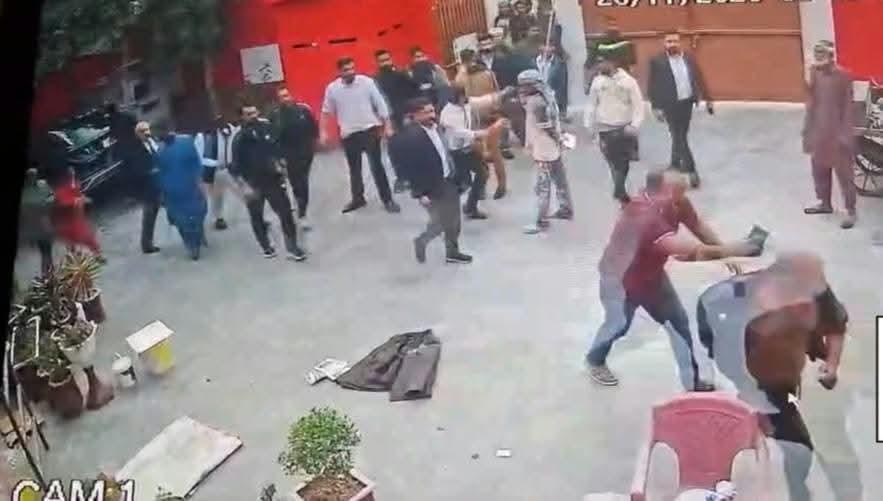
Gujranwala, Pakistan: The survival and stability of any civilized, democratic society depend on the extent to which the rule of law is established. In the eyes of the law, there should be no distinction between the rich and the poor, the powerful and the weak, or the majority and the minority. Unfortunately, in our society, power, official position, and professional influence are frequently observed acting as obstacles to justice.
A recent, distressing incident in Gujranwala reflects this bitter reality; it has not only raised questions regarding the supremacy of the law but has also sparked grave concerns—compounded by the silence of government circles, unrealistic statements from ministers, and the broader issue of the protection of minority communities. According to the details of the incident, Saeed Bhatta—a member of the Punjab Bar—parked his vehicle in front of the main entrance of a local church.
When the church’s security guard asked him not to park there, Bhatta reacted with anger, brandishing his status and the authority associated with his legal profession (symbolized by his 'black coat'). The security guard, undeterred, insisted that the vehicle be moved, which led to a verbal altercation involving abusive language. Although the pastor’s son attempted to de-escalate the situation by taking the security guard aside, Saeed Bhatta—along with Rizwan Gul, a candidate for the Gujranwala Bar—allegedly entered the church premises and the pastor’s residence, where they reportedly assaulted Pastor Arif Siraj and other church staff.
Following this incident, the aggrieved party—Pastor Arif Siraj—sought legal recourse by submitting a formal application to the local police. Rather than relying solely on verbal allegations, the complainant provided the police with CCTV footage and other concrete evidence. Based on this evidence, the police registered a case (FIR) against the accused under various legal provisions.
The situation took a deeply alarming and frightening turn when, following the registration of the FIR, the accused began threatening the complainant with dire consequences. Simultaneously, the Bar Councils of Gujranwala, Sialkot, Narowal, Phalia, and Gujrat issued strong reactions and statements opposing the case. The fact that members of the legal fraternity—who have sworn an oath to uphold the law—are demanding the quashing of the FIR and pressuring the complainant, rather than allowing the investigative process to proceed, raises several serious questions.
This is neither the first nor an isolated incident. Throughout the current year, a series of attacks on temples and churches, acts of vandalism, and the desecration of minority places of worship across various parts of the country have pushed the sense of insecurity among these communities to an extreme level. It is deeply regrettable that whenever places of worship belonging to minorities are attacked, or their religious leaders are subjected to violence, the state and government respond merely with perfunctory statements. Meanwhile, on the ground, there is criminal negligence in providing justice and protection to the victims. In this entire scenario, the role of the relevant government officials has been the most disappointing. The criminal silence and lack of interest displayed by Punjab’s Minister for Minority Affairs regarding this grave incident have left the minority community profoundly disheartened. The primary purpose of this office is to ensure the safety of the lives, property, and places of worship of the minorities residing in the province; yet, the incumbent’s failure to seek redress for the victimized priest—or to speak out against the influential perpetrators—proves that the concerns of minorities have been reduced to nothing more than ceremonial events and photo opportunities.
Furthermore, the statements issued by the Federal Minister for Law, Justice, and Human Rights, as well as the Provincial Minister for Religious Affairs, appear entirely detached from the harsh realities on the ground. Making claims within legislative chambers or at conferences—asserting that "minorities in the country enjoy complete protection and that interfaith harmony is exemplary"—is tantamount to obscuring the bitter truths of the situation. When a church premise is breached and a pastor is subjected to violence—with CCTV evidence available, the accused issuing open threats, and Bar Councils stepping in to shield the perpetrators—then the "all is well" statements from government ministers are akin to rubbing salt into the wounds of the victims. It is undeniable that one should strictly avoid casting personal, social, or legal disputes in a religious light, as doing so breeds hatred and division within society. However, ignoring ground realities and concrete evidence—while offering blind support to individuals based on professional affiliation, power, or communal ties—is equally contrary to the fundamental requirements of justice. If, on one hand, we argue against giving a religious color to such matters, then, on the other hand, attempts to suppress the issue through the use of professional influence and intimidation must be considered just as condemnable. It is an established fact that the mere status of Mr. Saeed Bhatta as a member of the Punjab Bar Council, or Mr. Rizwan Gul’s candidacy in a Bar election, does not place them above the law. It is entirely reasonable to ask the esteemed office-bearers of the Bar Councils: before making a unilateral demand for the withdrawal of the FIR, why did they not call for an impartial review of the CCTV footage and other available evidence regarding the incident that took place at the church and the pastor’s residence?
The most critical issue in this entire matter concerns human dignity and the sanctity of places of worship. Do the honor and self-respect of a priest, and the sanctity of a Christian place of worship, hold no significance? Are dignity, respect, and protection the exclusive rights of influential figures, government ministers, and lawyers? The straightforward and transparent path to justice is to allow this matter to be resolved on its own merits, rather than letting it be swayed by pressure, threats, or strikes. If the accused are truly innocent, a transparent investigation should establish their innocence; conversely, if the evidence proves the commission of a crime, strict legal action must follow. The Constitution of Pakistan guarantees equal rights to all citizens, regardless of their religion or ethnicity. Advocating for the protection of the constitutional, legal, and religious rights of the Christian community does not amount to giving an incident a "religious color"; rather, it is a demand for equal civil rights and the supremacy of the Constitution. As a nation and a state, we must recognize that neither wearing a lawyer’s robe nor holding a government office places an individual above the law; likewise, belonging to a religious minority does not diminish a citizen’s fundamental rights. It is imperative that government ministers acknowledge the ground realities, that Bar Councils uphold the cause of justice, and that the law is applied uniformly to everyone—without discrimination or exception.
You May Also Like
Karachi, Pakistan: Christian Lawyers Forum’s CLF calls for a comprehensive review of the Bill, particularly considering the following concern
Rawalpindi, Pakistan: RELIGIOUS PROTECTION FOR ALL OR SELECTIVE JUSTICE? Sardar Mushtaq Gill, Human Rights Defender and Lawyer, raises serious huma


PCP need your support that we may provide you better services: click on donate


"Trial of Pakistani Christian Nation" By Nazir S Bhatti
On demand of our readers, I have decided to release E-Book version of "Trial of Pakistani Christian Nation" on website of PCP which can also be viewed on website of Pakistan Christian Congress www.pakistanchristiancongress.org . You can read chapter wise by clicking tab on left handside of PDF format of E-Book.