
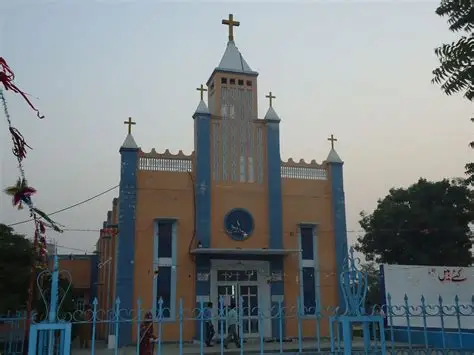
OKARA, PUNJAB, PAKISTAN: The reported disruption of a Christian worship service at Nazareth Town Church, Parish, Okara Cantt, has raised serious co
Legitimizing the Captor: How Pakistan’s Justice System Failed a Christian Minor. Report by Diam Qayyum
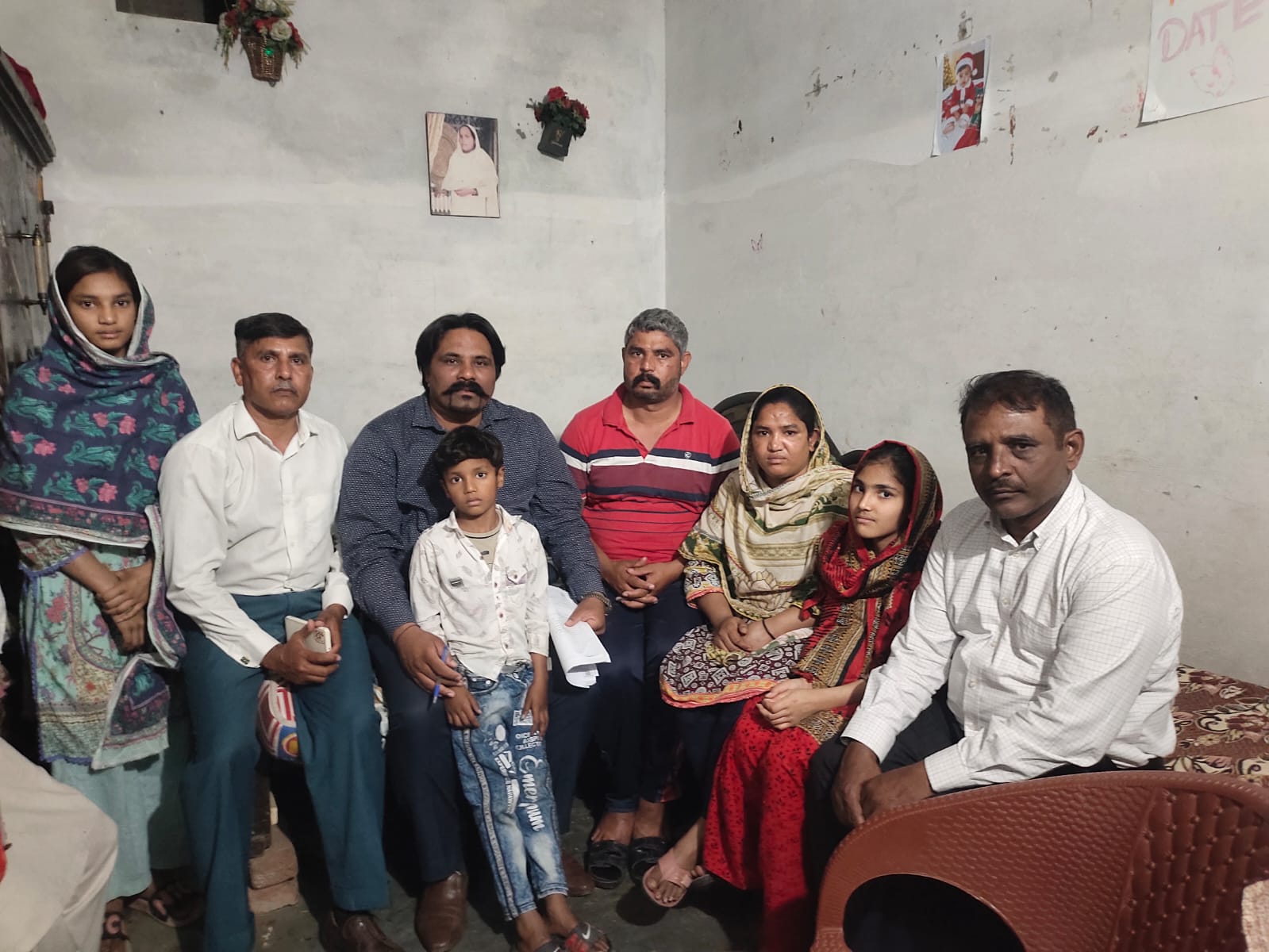
Pakistan: The legal battle of Shahbaz Masih v. Additional Session Judge, Lahore (F.C.P.L.A. No. 536/2025) is not just a simple story of a controversial final judgment; rather, it is a case study of its own kind where a poor family suffers just because the justice system of this country has been rotten to its core. The family not only struggled with the abduction of their daughter but also battled with corrupt political interference and a bureaucratic judicial loop. The case reached its climax at the Federal Constitution Court (FCC) only after the family was tossed in the Lower court and High court like a basketball. The case exposes the severe vulnerabilities of minority girls in Pakistan and the friction between codified statutory law and classical personal law.
Eventually, legal experts argue that the judicial system relied on procedural formalism that sidelined fundamental rights, diluted minority protections, and set a dangerous precedent for child protection.
The Abduction and the Battle Over the FIR (Mid-2025) The struggle of this family began in the early hours of July 29, 2025. At almost 5:30 AM, 12year-old Maria Shahbaz, a Christian girl from Lahore, was allegedly abducted by a 30-year-old Muslim mechanic, Shehryar Ahmad. On July 31, 2025, Maria’s father, Shahbaz Masih, managed to lodge First Information Report (FIR) No. 5144/25 under Section 363 of the Pakistan Penal Code, which is the offence of
kidnapping.
Within 6-7 days after the FIR was registered, a politically powerful individual affiliated with the PML-N used his influence to have the FIR dismissed, effectively stalling the police’s investigation and protecting the accused. In fact, Police was also not interested in this case. Through the intense efforts of human rights activists and the lawyers of the family, the police were forced to restore FIR No. 5144/25. Crucially, the restored FIR not only included the previous Section 363 but added heavier charges, which were 365-B (kidnapping, abducting, or inducing a woman to compel marriage), along with 420, 468, and 471 (cheating, forgery, and using forged documents). These later charges were a direct challenge and attack on the fabricated Nikkahnama and conversion documents, which were produced out of thin air by the accused.
The Judicial Merry-Go-Round (Late 2025) While the family was fighting to keep the criminal investigation alive, Maria surfaced before a magistrate to record a statement under Section 164 of the Cr.P.C., claiming that she had married Shehryar with her own “free will”; notice that she did not say anything regarding her willful conversion to Islam.
To recover her daughter, Shahbaz Masih filed a habeas corpus petition (Section 491 Cr.P.C.),
presenting NADRA records that proved that she was a minor – in fact, at the time of abduction, she was 12 years, 9 months, and 20 days old. What followed was a frustrating judicial loop where the family was bounced like a basketball between the lower courts and high courts. The Initial habeas corpus petition was dismissed by an Additional Session Judge, with the judge deferring to the minor’s “free will” statement. The family then appealed to the Lahore High Court via a writ Petition, but the LHC dismissed it. The family filed again at the session court level, this time before Additional Session Judge Justice Samina Hayat. The petition was once again dismissed. The family again appealed to the LHC, which sadly resulted in another dismissal.
Throughout this cycle, the lower courts repeatedly refused to invalidate the marriage. By doing so, they legally recognized the alleged abductor as the child's lawful “wali”, neutralizing the kidnapping charges and leaving the minor in the custody of Shehryar Ahmad.
The Ruling of the Federal Constitutional Court (Early 2026) Exhausted by the lower court options and their dismissals, the family of Maria filed a Federal Constitutional Petition for Leave to Appeal (F.C.P.L.A. No. 536/2025) at the newly formed Federal Constitutional Court (FCC). On March 25, 2025, a two-judge bench, comprising Justice Syed Hasan Azhar Rizvi and Justice Muhammad Karim Khan Agha, dismissed the father’s petition and made a ruling that shocked the legal and human rights communities.
They justified the Interfaith marriage and relied on Islamic Jurisprudence and historical Supreme Court precedents. The FCC ruled that a Muslim man may lawfully marry a woman from the Ahle-Kitab (People of the Book), and in turn effectively rejected the claim that a Christian-Muslim union was inherently void.
However, this framework entirely bypasses Christian theology. In Christianity, marriage is a sacred covenant created by God, and Christians are strictly forbidden from marrying nonChristians, as it violates the spiritual covenant. By imposing Islamic marital permissions, the court entirely disregarded the religious laws and marital bounds of the minor’s own community.
Another loophole in this ruling was that the court held that while the Child Marriage Restraint Act of 1929 penalizes the act of child marriage, it does not legally invalidate the marriage under Muhammadan Law if the girl has attained puberty.
The Court ruled that a simple declaration of faith, backed by a seminary certificate, was sufficient to prove conversion, calling any further inquiry “unwarranted interference”. Also, despite the active FIR charges of forgery (468, 471), the FCC dismissed the state-issued NADRA child registration certificates as “unreliable” due to bureaucratic delays. Instead, the court accepted the disputed “Nikkahnama” and noted that the girl’s physical appearance in the court suggested a “more advanced age,” and she is not a minor. Insights from Legal Experts and Activists Legal experts and minority rights activists have harshly criticized this ruling. Human Rights Activist Napoleon Qayyum stated, “We strongly oppose and condemn this unlawful and unethical ruling. We urge and expect the state to step up and act like a mother to protect minorities. State leaders should follow the example of Governor Muhammad Sarwar, the Leader who rescued a Sikh girl who was forcibly converted and married off, and returned her to her family – the task he accepted as his duty. Otherwise, we will push this matter further, even to the International Court of Justice (ICJ) and United Nations Human Rights Council (UNHRC), as is the family’s right”.
He added, “On 25 March, 2025, Lahore High Court sent a 12-year-old boy, Jamil Masih, to live with a local Muslim landlord, Muhammad Boota. This was based on the simple, unsubstantiated claim by lawyers that the boy read the Quran, loved reading it, and regularly went to Madrasa. And, we also condemn this ruling as well. The country’s law says a person cannot drive legally if they are under eighteen, so why is a minor sent off with a Muslim Landlord just because a baseless claim is made?”
Advocated Safdar, Director of Rah-e-Najaat, also commented, “We oppose this ruling and would challenge this ruling again in the FCC.” Advocate Kashif Alexander, Ex-President of Christian Lawyer Associated of Pakistan, told me, “The judgment of the Federal Constitutional Court dated 25 March 2026, wherein a two-member bench upheld the marriage of a 12-year-old Christian girl, Maria (name withheld), to an adult male, despite National Database and Registration Authority (NADRA) records confirming her minority; the Court disregarded documentary evidence, declared NADRA records unreliable, and relied instead on the concept of “maturity” (bulugh) under Islamic jurisprudence while accepting the alleged voluntary conversion and marriage, thereby raising serious legal concerns as the ruling directly conflicts with statutory protections under the Child Marriage Restraint Act (Punjab Amendment 2026) and Child Marriage Restraint Act (ICT Amendment 2025), which fix 18 years as the minimum age, criminalize child marriage, and invalidate minor consent; although Muslim Family Laws Ordinance 1961 permits a Muslim male to marry a Christian woman, such permissibility is subject to statutory compliance and does not legalize marriage with a minor, and thus the judgment exposes a fundamental conflict between classical Muhammadan law where puberty may be considered relevant and Pakistan’s codified legal system based on constitutional supremacy, public welfare, and child protection, wherein statutory law prevails over personal law in cases of conflict, making it clear that puberty cannot substitute the legally defined age of 18; consequently, the ruling appears to elevate subjective religious interpretation over binding legislation, undermines evidentiary standards, and raises constitutional concerns under Articles 9 (life and liberty), 14 (human dignity), and 25 (equality), while potentially encouraging misuse of religious conversion and increasing vulnerability of minority girls, and in my considered legal opinion, the judgment is contrary to statutory and constitutional principles, blurs the distinction between religious permissibility and legal validity, and sets a dangerous precedent, thereby necessitating urgent judicial review by a larger bench, reaffirmation of statutory supremacy, recognition of NADRA records as conclusive proof of age, and stronger legislative and judicial safeguards to protect minors and uphold the rule of law.”
Sohail Habel, Director of HARDS, said, “After this court ruling, it is very challenging for minorities, especially Christians, to even approach the judiciary. Aside from the corrupt Police system, the courts were the only recourse for the common man. Now that the courts are ruling in favor of oppressors, it is making the lives of Christians in Pakistan more difficult, particularly in a country where the misuse of the blasphemy law is already common.”
The Constitutional and Legal Fallout The judgment directly conflicts with codified statutory protections, such as the Child Marriage Restraint Act (Punjab Amendment 2026), which strictly fixes the marriage age at 18 and invalidates minor consent. The FCC elevated subjective religious interpretation over binding public welfare legislation.
The friction between statutory child protection and religious forces was starkly illustrated when political leader Mulana Fazal-ur-Rehman fiercely challenged the legal minimum marriage age of 18 on the floor of parliament. Defying the laws of the state, he declared, “I will now marry 16 year-olds, 14-year-olds, and 10-year-olds and sit with them, and I’ll see what you can do.”
Human rights defenders note with dismay that what once was a political threat has now seemingly been validated by the country’s highest constitutional court.
By accepting a 12-year-old's “consent” and conversion at face value, while she fully remained in the custody of her alleged abductor, the courts bypassed Article 20 (Freedom of Religion, which requires informed choice) and Article 36 (State protection of Minorities). The courts used the strict limitations of habeas corpus as a shield to avoid intervening in the matters by stating that facts like age are disputed and cannot be resolved in such proceedings, which in turn abandoned a vulnerable child while validating her captor’s custody instead of invalidating their marriage. Ultimately, the case highlights a systemic failure where political influence taints initial police action, lower courts trap victims in procedural loops, and the highest constitutional courts cling to outdated interpretive frameworks at the expense of human dignity and child protection.
You May Also Like
JORDAN: Sardar Mushtaq Gill, a human rights defender, lawyer and founder of LEAD Ministries, has strongly condemned the reported extremist attack o
LAHORE: Rwadari Tehreek Pakistan has written an open letter, signed by its Chairman Mr. Samson Salamat, to Chief Minister Punjab Maryam Nawaz Shari


PCP need your support that we may provide you better services: click on donate


"Trial of Pakistani Christian Nation" By Nazir S Bhatti
On demand of our readers, I have decided to release E-Book version of "Trial of Pakistani Christian Nation" on website of PCP which can also be viewed on website of Pakistan Christian Congress www.pakistanchristiancongress.org . You can read chapter wise by clicking tab on left handside of PDF format of E-Book.