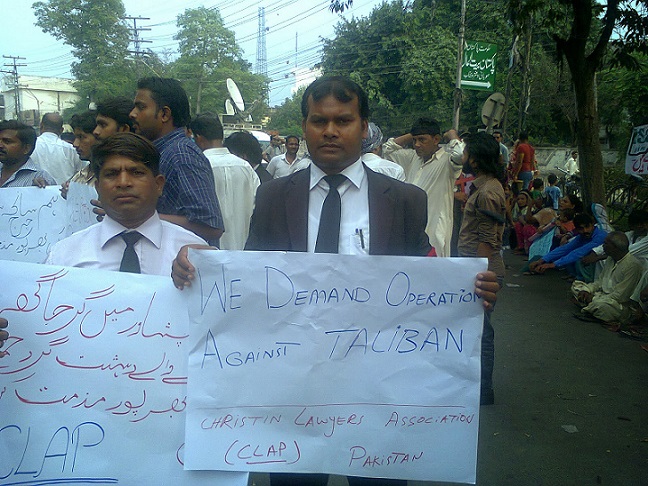
Faisalabad: January 18, 2015. (PCP) Chairman Pakistan Minorities Teachers’ Association Professor Anjum James Paul has written a letter to honorable justice Nasirul Mulk Chief Justice Supreme Court of Pakistan Ref. No. PMTA/25/14 on December.27, 2014 on the subject “June 19 verdict regarding the protection of minority rights and the Pakistani textbooks.”
Content of the letter is;
To
Mr. Nasirul Mulk
Chief Justice
Supreme Court of Pakistan
Islamabad.
Subject: JUNE 19 VERDICT REGARDING THE PROTECTION OF MINORITY RIGHTS AND THE PAKISTANI TEXTBOOKS.
Honourable Sir,
Greetings and well wishes from Pakistan Minorities Teachers’ Association (PMTA).
PMTA would like to draw your kind attention on the subject cited above
Pakistani religious minorities welcome the June 19 verdict of the Supreme Court of Pakistan regarding the protection of minority rights. It is expected that if there is implementation of this verdict with letter and spirit by the federal and provincial governments of Pakistan then all citizens will be treated equally and without any discrimination according to Article 25 (1) of the Constitution of Pakistan that guarantees equal rights to all citizens as it declares, “All citizens are equal before law and are entitled to equal protection of law.”
It is utmost need to take solid measures for the compliance of the court’s verdict because the federal and provincial governments have failed to protect the minority rights even after the June 19 verdict .Minority rights have been violated in the shape of burning alive, forced conversions and forced marriages. Worship places and Holy Books of the minorities have been desecrated. Minor girls and women are being abducted, raped, forcibly converted and married. Social, political, religious and economic rights of the minorities are being violated. There is still violation of Article 22 (1) of the Constitution of Pakistan and the minority students are invited to convert their religion/s due to the violation of this article. There are biases against the religious minorities in the textbooks of Pakistan
Sir, The Father of the Nation Quaid-e-Azam Muhammad Ali Jinnah in his presidential address to the Constituent Assembly of Pakistan on August 11, 1947 said, “We are starting in the days when there is no discrimination, no distinction between one community and another, no discrimination between one caste or creed and another. We are starting with this fundamental principle that we are all citizens and equal citizens of one State.”
It is the first and foremost responsibility of a state to treat all citizens equally. Though fundamental constitutional human rights have been guaranteed to all citizens in the Constitution of Pakistan but it is so sad that these rights have been deliberately violated by the governments against the religious minorities. There is discrimination with the citizens belonging from the religious minorities on the religious basis and they are deprived of exercising fully their fundamental human rights.
Sir, Pakistani minorities have played their equal role in the making of Pakistan. These were only Christians who were in a position to decide the fate of Punjab ,either to unite or divide Punjab. They used their decisive votes for the partition of Punjab and thus Punjab became the part of Pakistan by the votes of the Christians. The religious minorities of Pakistan played their prominent role side by side with the Muslim minority in the undivided India with a dream that their rights would be protected in Pakistan. This dream can become a reality if biases and discrmination against religious minorities are removed from the textbooks and elsewhere. Pakistani religious minorities are not a guest or immigrant but are the partners of this land.
Pakistani textbooks published in 2013 and 2014 for grade I to grade XII have violated Article 22 (1) of the Constitution of Pakistan, Article 26 (2) of the Universal Declaration of Human Rights, Article 2 and Article 14 (1) of the Convention on the Rights of the Child, Article 5 of the Declaration On The Elimination Of All Forms Of Intolerance And Of Discrimination Based On Religion Or Belief, Article 18 of the International Covenant on Civil and Political Rights and Guidelines of the National Curriculum 2006-2007, Government of Pakistan, Ministry of Education.
Constitution of Pakistan
Article 22 (1)
‘No person attending any educational institution shall be required to receive religious instruction, or take part in any religious ceremony, or attend religious worship, if such instruction, ceremony or worship relates to a religion other than his own.‘
Universal Declaration of Human Rights
Article 26
(2) ‘Education shall be directed to the full development of the human personality and to strengthening of respect for human rights and fundamental freedoms. It shall promote understanding, tolerance and friendship among all nations, racial or religious groups, and shall further the activities of the United Nations for the maintenance of peace.’
(3) Parents have a prior right to choose the kind of education that shall be given to their children.
Convention on the Rights of the Child
Article 2
‘States Parties shall take all appropriate measures to ensure that the child is protected against all forms of discrimination or punishment on the basis of the status, activities, expressed opinions, or beliefs of the child’s parents, legal guardians, or family members.’
Convention on the Rights of the Child
Article 14
(1) ‘States Parties shall respect the right of the child to freedom of thought, conscious and religion.’
Declaration On The Elimination Of All Forms Of Intolerance And Of Discrimination Based On Religion Or Belief
Article 5
1. The parents or, as the case may be , the legal guardians of the child have the right to organize the life within family in accordance with their religion or belief and bearing in mind the moral education in which they believe the child should be brought up.
2. Every child shall enjoy the right to have access the education in the matter of religion or belief in accordance with the wishes of his parents or, as the case may be, legal guardians, and shall not be compelled to receive teaching on religion or belief against the wishes of his parents or legal guardians, the best interests of the child being the guiding principle.
3. The child shall be protected from any form of discrimination on the ground of religion or belief. He shall be brought up in a spirit of understanding, tolerance, friendship among peoples, peace and universal brotherhood, respect for freedom of religion or belief of others, and in full consciousness that his energy and talents should be devoted to the service of his fellow men
4. In case of a child who is not under the care either of his parents or of his legal guardians, due account shall be taken of their expressed wishes or of any other proof of their wishes in the matter of religion or belief, the best interests of the child being the guiding principle.
5. Practices of a religion or beliefs in which a child is brought up must not be injurious to his physical or mental health or to his full development, taking into account article 1, paragraph 3, of the present Declaration.
International Covenant on Civil and Political Rights
Article 18
1. Everyone shall have the right to freedom of thought, conscience and religion. This right shall include freedom to have or to adopt a religion or belief of his choice, and freedom, either individually or in community with others and in public or private, to manifest his religion or belief in worship, observance, practice and teaching.
2. No one shall be subject to coercion which would impair his freedom to have or to adopt a religion or belief of his choice.
3. Freedom to manifest one's religion or beliefs may be subject only to such limitations as are prescribed by law and are necessary to protect public safety, order, health, or morals or the fundamental rights and freedoms of others.
4. The States Parties to the present Covenant undertake to have respect for the liberty of parents and, when applicable, legal guardians to ensure the religious and moral education of their children in conformity with their own convictions.
Guidelines of the National Curriculum 2006-2007, Government of Pakistan, Ministry of Education Islamabad;
According to National Curriculum 2006-2007, Government of Pakistan, Ministry of Education, Islamabad, the textbook is an important Teaching and Learning Resource. It is one of the most extensively used resources and serves as a framework for teaching. To prepare such a strong resource, the textbook writers are requested to follow the under mentioned guidelines.
• The textbook should confirm in all its details to the parameters laid down in the curriculum.
• The material must be sufficient to give students the knowledge they need to understand concepts, develop skills and engage in higher order thinking.
• The material should help students understand the world in which they live, prepare for exams, prepare for life, raise their standard and promote independent thinking.
• The language of the narrative should be simple, clear and logical and should not be loaded with unnecessary details and repetitions.
• The material should be unbiased and non-controversial.
• Textbooks should be well illustrated.
• A number of activities should be recommended in the textbooks.
• End-of- the –chapter exercises must encourage students to think, develop skills, and use information for a variety of purposes.
For developing textbooks on Ethics special care needs to be taken while developing sections on ‘Introduction to religions’, ‘Ethics and Moral Values’ and ‘Personalities’.
Introduction to religions
• Use the narrative form of story writing
• Avoid theological details.
• Do not use any comparisons between or among religions.
RESERVATIONS
1. National Curriculum 2006-2007 and present textbooks have caused severe damages to the Pakistani nation. The present curriculum and textbooks have played the role of a ‘divider’ instead of a ‘connector’ as it is obvious from the textbooks which have been developed according to the National Curriculum 2006-2007. Pakistan Minorities Teachers’ Association has published research based documents on the textbooks from grade I to grade XII in different subjects like History, Social Studies, Pakistan Studies, Urdu, English, General Knowledge, Islamic Studies and Ethics of National Book Foundation Islamabad, Punjab Textbook Board Lahore, Sindh Textbook Board Jamshoro, Balochistan Textbook Board Quetta and Khyber Pakthtunkhwa Textbook Board Peshawar in October 2014. There has been use of vulgar language, propagation and disinformation only against the minority religions and religious minorities in the textbooks published under the umbrella of the federal and provincial governments of Pakistan in 2013-2014. The research identifies that the National Curriculum 2006-2007 and the textbooks have violated Article 22 (1) the Constitution of Pakistan that guarantees, “No person attending any educational institution shall be required to receive religious instruction, or take part in any religious ceremony, or attend religious worship, if such instruction, ceremony or worship relates to a religion other than his own.”
In the present textbooks, students of different religions are considered of one religion. These textbooks preach only one religion, invite the attention of the students to convert only to one religion, promote religious identity of only one religion and promote dignity of the followers of only one religion which is the violation of constitution.
2. Ministry of Education (Curriculum Wing), Government of Pakistan, Islamabad ensured in a letter No.F.3-17/2007-IE to Prof. Anjum James Paul, Chairman PMTA on 19 September 2007 that ‘there are no biasis in future books.’ The textbooks published in 2013-2014 are biased against the minority religions and the religious minorities of Pakistan. Textbooks are the main cause of extremism and violence in Pakistan. It is so sad that Pakistani textbooks have always been a threat to the lives and properties of the religious minorities that are not considered Pakistanis. They feel insecure and are segregated.
National Education Policy 2009 , National Curriculum 2006-2007 and the textbooks are biased against the religious minorities. After reading these textbooks one can easily prey religious minority his/her target and ultimately the religious minorities can be burnt alive, abducted, minor girls and women can be abducted ,forcibly converted and married. There can be desecration of the Holy Books and worship places of religious minorities.Their properties can be grabbed.Their houses can be demolished and burnt to ashes after looting .They can be segregated from the mainstream.There can be religious, social, economic, political discrimination and persecution with the religious minorities on the basis of religion.
According to the research Pakistani textbooks present Islamic identity to Pakistan, Pakistan as a state of only Muslims, divide Pakistani nation on the basis of religion, create complex of majority and minority, Quaid-e-Azam as a leader of only Muslims, comparison among religions, let down the Holy Books of religious minorities, desecration of the worship places, let down the Hindu religion, teach Christian beliefs in a different way, provoke religious violence, instigate students to Muslim -Christian violence and Muslim- Hindu violence, biases against Christians, biases against Hindus, biases against Sikhs and discriminatory attitude with the minority students.
RECOMMENDATIONS
1. All hate literature against the minority religions and religious minorities must be abolished immediately from the textbooks and to include material on the respect of all human beings, human rights, social harmony, peaceful co-existence, understanding the world, respect for all religions and their followers.
2. There must be representation of educationists from the minorities while developing National Education Policy, National Curriculum and textbooks so that biased free and non-controversial education may be inculcated and there may be full grooming of the personality of the child for a better human being for the society.
3. Provincial Curriculum Authorities and Provincial Textbook Boards must be autonomous institutions. Curriculum Authority of any province must focus only on the value based and need based curriculum and to finalized manuscript while the responsibility of the textbooks must be only publication and supply of the textbooks so that there may be selection of the textbooks for publication on merit to increase creative learning in the students.
4. Teachings of any religion must be only in the subject of ‘Religion’ or particular subject designed for the students of that particular religion.
5. Immediate arrangements must be made for the subject of ‘Religious Education’ developed by the educationists of the respective religions and of the teachers must also be provided as in the case of Muslim students who are studying ‘Islamic Studies and being taught only by the Muslim teachers. The students of religious minorities have boycotted the textbooks in the subject of ‘Ethics’ as vulgar language, propagation and disinformation has been used against their beliefs and religious practices. The subject of Ethics only for the students of the religious minorities is discrimination and open violation of Article 22 (1) the Constitution of Pakistan because they have to study nine religions while majority students are exempted from this subject. The minority students prefer the subject of Islamic Studies to avoid religious discrimination. Appearing of minority students in the subject of Islamic Studies is violation of Article 22 (1) of the Constitution.
6. All the nationalized missionary schools and colleges must be returned to the missionaries without any further delay. Besides this there must not be interference in the administration of the missionary educational institutions.
Sir, PMTA requests the honorable bench of the Supreme Court of Pakistan headed by you on the protection of minority rights to order the federal and provincial governments to treat all citizens equally according to the fundamental human rights guaranteed in the Constitution of Pakistan 1973.
PMTA expects that if curriculum and textbooks are designed according to Article 22 (1) and Article 25 of the Constitution only then there can be guarantee of the minority rights in Pakistan
PROF.ANJUM JAMES PAUL
CHAIRMAN
Note: Following research based documents attached herewith;
1. Biased Pakistani Textbooks
2. Article 22 (1) of the Constitution of Pakistan and Pakistani Textbooks
3. General Standard of Pakistani Textbooks