
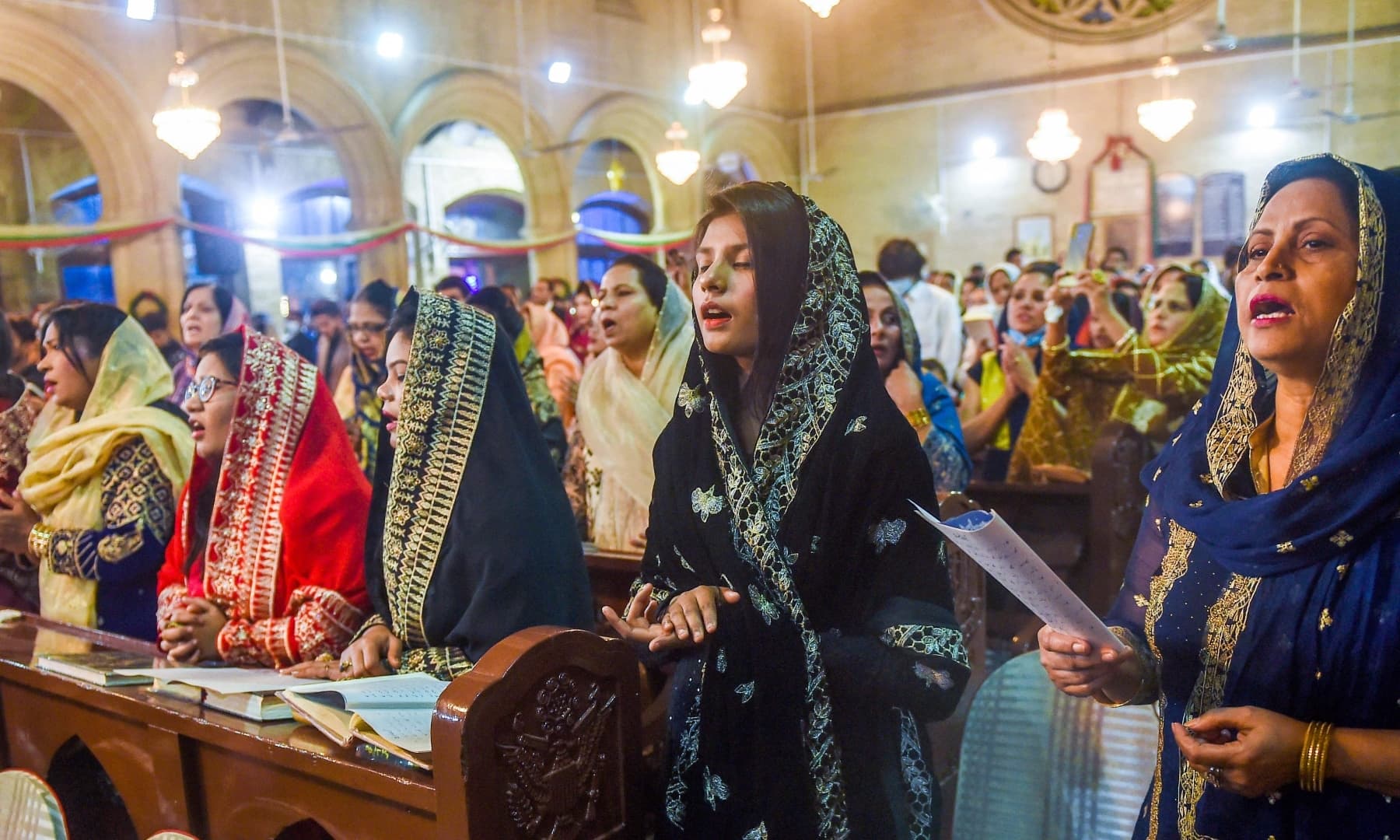
FAISALABAD, Pakistan: A Christian woman from an exceptionally vulnerable family in Faisalabad is pursuing justice after allegedly fighting off a ne
A Family waiting for Asylum for Five Years speaks with Parvez Iqbal, President PCC-Holland Chapter

Early in the morning as I opened my email box, I felt both, surprised and happy. Surprised because I would remain so near to this family while still unaware of the full extent of their problems.
Being familiar with pen and words, I thought I was doing what was expected of me to the best of my abilities, but I was wrong and am not sure how many more families there are around whose voice I have to bring before the authorities to secure their rights and their release from constraints on their freedom of action and movement..
What made me feel happy was because they trusted me and gave me a chance to serve them.
After having contacted them by telephone, I fixed a time to meet them. I left for their residence, Building "C" room Nos 23 and 24 in a refugee camp situated in a village named BORNE. It took me 85 minutes to cover 157 kilometers distance from my home to their refugee camp. During all this time I kept preparing myself for discussions and questions with them. After parking my car, I approached reception counter, where Kamran, the second son of the family, was waiting. The security officer on duty put routine questions and then returned my passport with a visitor pass and instructed me to return the visitor pass on leaving camp not later than 9.00 p.m. After giving an affirmative answer to the security officer, I started moving towards their room with Kamran. While passing corridors I saw at right and left many refugees of different nations, colours and languages busy cooking; they looked at us with eyes full of questions and hoping to be the first to help. They may have thought this new face was a new refugee in the camp, and were as usual trying to be first in helping newcomers in the camp. I am very well aware of this because six years ago I was in a refugee camp with the same status and the same thoughts. During walk through the camp, all the days of my past reminded to mind, flashing as an electric signal through my head.
Thus reliving briefly all memories of my past, I arrived with Kamran at the entrance of Building "C" where I found Mr. Younas waiting. After a routine welcome he took me inside the room. In this small room, after installing two beds, two small cupboards, one table and a chair, there was not enough space left for a person to stretch his/her legs and relax for a short time. Yet they are required to accept leading life in this small room, as they have no other option.
Still looking around and considering their living in this room, I saw Mrs. Younas entered with their young daughter.... and after traditional greetings I decided to drink a glass of water and after paying my thanks and offering all possible assurances I started to inquire about the latest five years of their past.
Mr. Younas, after thanking me, summarized all that had happened in the past 5-6 years and provided the following information:
"After great efforts and difficulties should it be better to tell what were these difficulties? I fled from Pakistan with my wife and 4 children and on arrival in Holland asked for asylum with full hopes of receiving shelter and support quickly, but we faced a first shock with regard to my eldest son Imran, who had severe wounds on his feet through the attacks he suffered in Pakistan and that did not heal because he suffers from sugar-illness. He did not have medicaments at the moment because our travel-agent had warned us not to tell he was diabetic. Because we were very afraid, we did everything he told us. Imran tried to control himself with all the pains and wounds but after one week when his condition got even worse, he was instantly hospitalised and for three days kept in a Very Intensive Care Unit. After three days he was diagnosed as having sugar illness and got his right medicaments. We were still in this shock condition and trying to stand on our own legs when Immigration authorities expelled us from the refugee camp as a result of our asylum request being denied. Immigration officials directed us to approach an NGO in Amsterdam for shelter and further help."
Here I interrupted Mr. Younas with the question: What were the reasons your asylum application was rejected???
Mr. Younas, after regaining control of his emotions and voice, slowly answered "when life is not safe in one's home land, how can one expect strangers to give protection??? That is what we experienced. The immigration authorities just said that they did not believe all we said and explained. We then went to Amsterdam and approached the NGO at the address given to us; the first action they undertook was to break up our family; my wife and daughter were allowed to stay there in the hostel, but my three sons and myself were sent to an address in another city, " Utrecht ". On our arrival at Utrecht , they did not even allow us to enter the building and while insulting us they threw us into the road and we travelled back to Amsterdam . This time, out of mercy with us, the hostel management allowed us only for the night in the hostel, to sleep there. The whole day after that we kept together and spent our day at the Railway Station of Amsterdam; for night shelter we had to go separate ways but during all day we felt helpless and in steady fear of the police and what they might do for our staying illegally, and these fears increased our worries with time.
After no more than three days, Hostel Management refused to give us shelter anymore and we were thrown again on the street like garbage; once again we felt ourselves all alone amid millions of people around. I felt like caught between two oceans and was only hoping for a miracle through our prayers that God would send some Moses to us who could pave our way through this deep ocean of people. All our countrymen had taken possession of all our things and tried to kill us, and we surely thanked God for rescuing us from that grave by getting us to Europe . We heard there is love everywhere but all we received was insults and hate.
Our children were passing their time by moving individually from one railway platform to another and we as husband and wife, in addition to our own troubles, worried about the poor condition of the eldest son, which added to the burden of our routine and daily worries. It is said that when people in this world give up thinking, then God will take control and protect His people. Exactly that is what happened to us. A lady wearing Pakistani dress walked and passed in front of us. I told my wife to stop and ask her for help, may be she could take pity and help us. She was approached and kind heartedly she agreed but asked if she could first call her husband. After her call, her husband arrived at the station and they took us to their home. We thanked our God Almighty for helping us in such a miraculous way..
We discovered that she knew Shazia, our eldest daughter who had to flee with her husband and little son in 1999. Since a couple of years we had succeeded to get contact with her and knew she was alive and living in Holland . But again our travel-agent had forbidden us to tell anyone we had a daughter there, so we obeyed him of course and didn’t even have her address nor phone-number with us. The Pakistani lady called Shazia who was crying and weeping for months because we were lost. So immediately she came to see us. After some deliberations with her Dutch “mother”, Mrs. Ingrid, she decided to take us all to her house and the day after to Mrs. Ingrid’s house (she had a very large house) near to Heerenveen. She and the church whom she was belonged to provided all possible care for our life, food, shelter, health and everything for almost one year, including ensuring kidney surgery for our eldest son Imran and language classes for us to learn the Dutch language. Not only this, she also helped to find a better lawyer to get us again through Immigration procedures for a second attempt. But after four years this second asking for asylum was refused. The reason: the IND discovered we had used false names. And we did indeed, we had been obliged by the travel-agent to do so, we did not know why, we thought he knew the best. So at this moment we will soon start a third procedure, but we are very afraid about the results.
During all this time of misery, how we mentally, physically, morally and spiritually suffered is hard to explain, and even now we feel our souls trembling when recalling all those days. But I now want to enlist your newspapers and associations for making public our voice and for bringing our plea before the competent authorities so they might please give us freedom and security of life. What we need to live we will not beg; we will obtain it by our own efforts. We wish to be treated as human beings and enjoy the human rights we deserve."
Once again on my instigation Mr. Younas briefly said that during all these times of suffering, he was four times severely attacked with paralysis, losing the use of the left side of his body. When still in his home land he had been a member of a team of prominent football players, but now he is spending life as a disabled person. Mr. Younas already suffered a very serious double attack (brains, then heart) in 2002. "Maybe this is a my punishment for asking asylum here in this country."
On being asked about the medical treatment he had received, Mr. Younas showed his satisfaction and said: "As a result of timely action and proper treatment, I am now talking to you even after four severe attacks of paralysis. But there is no prospect of further improvement of my present health condition. This has been confirmed by the doctors about my health", said Mr. Younas.
Mr. Younas further explained that his powers of memory have also suffered badly. "I tend to forget things within seconds, with the result that I forget that I have to stay all the time at home and if I go outside, often I forget the way back home, and this has increased the worries of my family members. Doctors have also advised me to keep a mobile cell phone always with me, but I cannot operate it myself and have lost 3 or mobile phones, not even knowing where.
When, on my request, Mr Younas had narrated his story in proper order and in detail and had described the way his mental condition had been affected, he said with tearful eyes: "I can only call these memories my own, for I have lost everything, my country, language, home, family, honour and respect; everything I have lost and now have only these few memories to live with. All I can hope for is being allowed to live on with my memories and receive respect and honour, but nobody trusts us. Sometimes I think may be we do not know how to tell the truth effectively. It is said that in the end truth always prevails, but in our situation I fear that the truth is that we have no hope left.
BUT UNTIL WE DIE WE SHALL NEVER GO THE WAY OF FALSEHOOD.
Explaining about the other family members Mr. Younas said that, owing to persistent troubles, worries and mental afflictions, his wife had been diagnosticised as a diabetic; she is also having hernias in her neck and often suffers bad fits of migraine.
The eldest son Imran has been granted asylum because of his health conditions and the operation (he got both a new kidney and pancreas) he had, but his living alone always keeps us in permanent worry. We are all in a refugee camp so we cannot stay with him as temporary guests, and because of the cost of travel we cannot visit him regularly to look after him. Many times we tried to apply for his being re-united with his fiancée in Pakistan but we were always disappointed. Far away she has been waiting for the last eight years, everyday waking-up with hopes that today she will get permission to come to her promised husband, but after every whole day of waiting and disappointment she will have to go to sleep to renew her dreams of hope. For all we wish, we cannot help her nor do anything for her. Even from any humanitarian or women's international or local organization no woman has turned up to say a few words of comfort or help her in any way. What will happen to her? This worrying thought is haunting us all the time.
Next in age after him is Kamran, We are most concerned about him. He underwent the hate of a young Muslim refugee three years ago in a refugee camp. Kamran was severely beaten by him for being a Christian. The camp manager transferred that Muslim boy to another camp but he left with threats and very badly insulted all of us, including our women. Ever since that boy's threat to take revenge we have been in extra worries about Kamran. We have asked Kamran never to go alone outside the camp or outside home. He thus virtually has house arrest and this has destroyed all his possibilities of career, education and other things. In this hopeless asylum situation he can neither follow any course or training nor is he permitted to study or join a language school. What life has in future for him we cannot be sure.
I want to explain you very clearly that the story of this family is not a common story of the average refugee. Yes, they had to flee from their home-country like all of them. But in the years that followed, they always lived in fear about the life of the eldest son, Imran, who was so very ill and nearly died several times. After his operation in 2007 they felt very comforted. But in 2008 a new danger threatened the life of the whole family: the youngest son, Nasir, got a relation with a Muslim girl, and the girl ran away from home because her family kept her behind closed doors and wanted to marry her to a nephew. Her family started to threaten this whole family to kill them (indeed, honour killing in Holland happens more than you think) and they needed to be protected by the police for more than one year. They had to move to another AZC, they could not leave the camp, the daughter could not go to school and received threatening sms. They never thought to suffer again from Muslim in this Christian country.
The life of the youngest son, Nasir, is trapped in a dead-end of misery. He cannot plan nor hope anything for himself nor for his wife and one-year-old son. The husband and wife had dreamed of coping with all sorts of hardness so as to achieve a happy home and a bright future for their son, but in the present circumstances, Nasir has no hope for his own status and life, and how can he manage as a father and husband? In all situations, whether present or future, his newly born son is suffering badly and facing punishment for violating laws and conditions he cannot ever have known about; thus he is heading for an unknown destination. No matter who is at fault, or how strict rules and laws are, how can one blame this child, which is still so young, and why is he to suffer for things of which he is not aware, simply expecting some comfortable in life? Who is to give voice to the cries for help of this innocent and child, unable to speak for itself?
Despite their good intentions his parents are tied in rules and hand-cuffed. In this situation, is there no law to protect the legal rights of this innocent child, upheld by organizations that have worldwide recognition? No law that will warrant the freedom and opportunities for his parents to raise this one-year-old child according to their own conscience and hopes? The way I see it, such a responsibility is the right of every person in the community, regardless of social, cultural, religious or similar considerations.
I asked Nasir to answer a question about the constraints and difficulties he has to cope with. He said: "In the present situation I am not allowed to undertake a study or develop a career, nor am I allowed to do paid work to stand on my own feet in supporting wife, son and household. Not only that, but there is the persistent fear that the permission to stay here with my wife and son will be retracted, so how long I have to suffer nobody knows. For full six years of life we have here faced hate, disillusion and failures, and I don't know when a light of hope could begin to shine in our lives, nor do I know how much more time it will take to be granted the legal rights a human being deserves. Where there is no hunger, we do not try to obtain luxuries such as delicious and warm dishes with of all varieties of food. What we want is to work hard and struggle to achieve a better life as a respectable family of this country, abiding by all the rules and contributing our share in the development of this country. We are capable of providing for ourselves but we need opportunities.
In the family the youngest daughter, not yet mature, had to leave school and books, classmates and friends to change over to the life of a refugee. "At a time when I could expect to enjoy life with my friends, I was transferred from one refugee camp to another, and thus became aware of the importance of freedom. What value is comfort and easy life inside a golden cage with a big lock? That is my situation. Fortunately I have been granted admission to school and permission to attend classes at my own expense, but when turning up for exams, I have much poorer chances than my brothers. My parents have dreamed a bright future also for me. I myself once dreamed of building a successful career by respectful means, but the biggest barrier is having to wait for a permit to stay. I see only an ocean of disappointments ahead and nothing else. In these circumstances, who will act as Moses and clear my path through this sea of disappointments and neglect?
I am suffering as a refugee yet fulfilling my responsibilities as a daughter and Asian woman. I am determined to keep the respect of my family and parents and will always remain honest to them. Last year when my father had an attack of paralysis and was in hospital, every one in our family was worried about his health and recovery, but father was most worried about me and my future, more than about his own life. I hated myself then for being only a daughter who could not help my father and even caused him extra worry on top of his fear of losing life. He wanted to lessen his worries about me by getting me engaged. Keeping in mind his health condition everyone including myself agreed and I was engaged last year in keeping with all our customs and traditions.
In my present and insecure situation, what will happen to me? I ask this of every father in this world, all the relevant and competent authorities, women's national and international organizations, Human Rights workers and makers of laws for the protection of refugees. I have spent the golden years of unmarried age facing difficulties as a refugee, undergoing disappointments and neglect from all sides. Now I beg , please allow me to breathe free air, and to be treated as a human being deserving a good and happy life. My request to all of you is, please give me a free and torture less life in your refuge. I assure you all, I will do all I can to achieve a good life and build a respected career while abiding by all the rules and regulations of this country. Thank you."
Listening to this appeal of this daughter of Eve, my forehead turned all wet and my heart filled with pain, even my whole body started shivering but, controlling my emotions, I assured her that her request will be presented to the addresses she would wish, and then turned to Mr Younas with the question "How was the behaviour of our Pakistani Christian Community during all this procedure????" Mr. Younas, after taking a long breath, apologized for restricting his comment on this to two lines of poetry in the Urdu language, which run as follows:
"In this city who will wipe our tears?
I see every one’s clothes are wet."
He, with all his hopes, promised to raise his voice and bring before the proper and competent authorities his request for their practical help in a spirit of mercy. He was sure there must come some good out of this.
Throughout these talks I noticed many emotional scenes in the family and everyone helping and supporting each other to control emotions, to inspire courage and to be brave with these words "everything will be alright"
That fleeing to save life, asking for asylum and getting permission is so difficult, I have now heard for the first time. I am sure this is not all. If I meet another family, they might have even bigger troubles in their life than this family. Yet listening to this family and hearing all that happened to them during these past 5-6 years, my heart is oppressed and my eyes are filled with tears. I hope yours are, too. I am sure our support and prayers will help them to overcome their troubles and obtain a properly human life.
Let us cross fingers and pray for their happiness in a pleasant life.........
You May Also Like
SHEIKHUPURA, PAKISTAN: “Bring my son home.” Behind these words is the desperate cry of a Christian mother who says she has been separat
Sardar Mushtaq Gill Calls for a New Standard in Bible Distribution: “A Bible Must Be Read, Not Simply Distributed”
LEAD Minis


PCP need your support that we may provide you better services: click on donate


"Trial of Pakistani Christian Nation" By Nazir S Bhatti
On demand of our readers, I have decided to release E-Book version of "Trial of Pakistani Christian Nation" on website of PCP which can also be viewed on website of Pakistan Christian Congress www.pakistanchristiancongress.org . You can read chapter wise by clicking tab on left handside of PDF format of E-Book.