
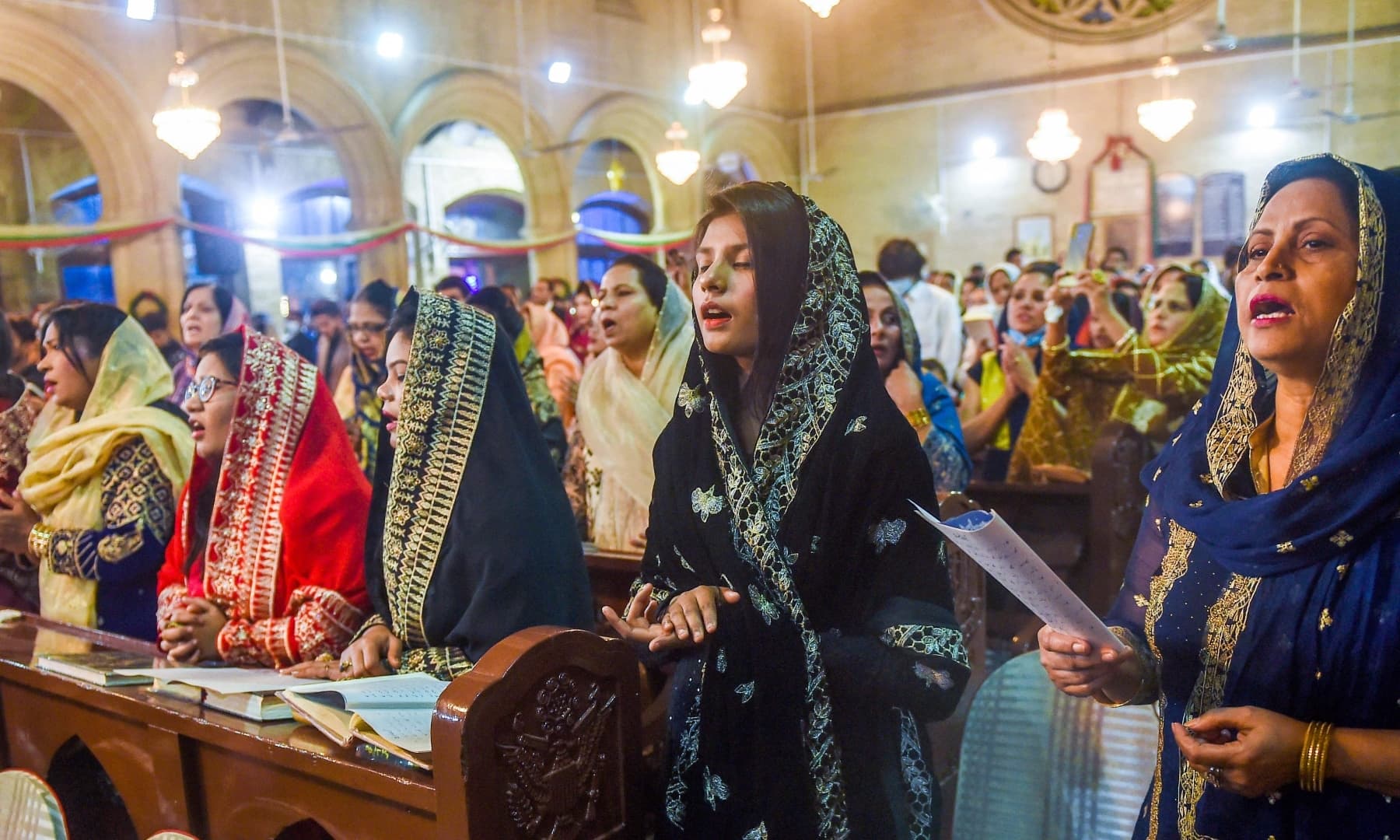
FAISALABAD, Pakistan: A Christian woman from an exceptionally vulnerable family in Faisalabad is pursuing justice after allegedly fighting off a ne
Objections to the Objectives Resolution: A Minorities¡¦ Perspective: By Rev. Rana Youab Khan

Nowadays, this question is widely under discussion in the Pakistan media, ¡¥Are we going into another phase of tension between the government and the Judiciary¡¦? On April 18th the National Assembly of Pakistan passed the eighteenth amendment of the constitution of Pakistan but already, a full bench of the 17-member of Supreme Court chaired by the Chief Justice of Pakistan Mr. Iftikhar Muhammad Chaudhry, had start hearing a set of petitions challenging certain provisions of the 18th Amendment.
Under particular challenge was the formation of a judicial commission for the appointment of superior court judges. The decision taken by the Judiciary and the response of the government will determine the future of the amendment. This is the first time in the history of Pakistan that a president has relinquished a significant part of his powers willingly and transferred them to parliament and the office of the prime minister. The 18th amendment also includes an aspect of concern to the minorities, which has been acknowledged by the Chief Justice of Pakistan. He said, credit must go to the present parliament, which after 25 years took notice of the brazen way in which the word 'freely', relating to minorities¡¦ rights which had always been part of the Constitution had been removed and would now be restored in the Objectives Resolution.
The article is written as response to the Objectives Resolution and its role for the Islamisation in Pakistan, in the light of restoration of the word ¡¥freely¡¦ in the constitution of Pakistan. The first Constituent Assembly came into existence under Indian Independence Act 1947. The members from the districts that became part of Pakistan were declared members of the Constituent Assembly. On 12 March 1949 after the death of Mr. Jinnah, the Objectives Resolution had been adopted by the Constituent Assembly of Pakistan , during the time of Liaqat Ali Khan the first Prime Minister of Pakistan. The Objectives Resolution, which combines features of both Western and Islamic democracy proclaims the following principles:
1. Sovereignty belongs to Allah alone but He has delegated it to the State of Pakistan through its people to be exercised within the limits prescribed by Him as a sacred trust.
2. The State shall exercise its powers and authority through the chosen representatives of the people.
3. The principles of democracy, freedom, equality, tolerance and social justice, as enunciated by Islam, shall be fully observed.
4. Muslims shall be enabled to order their lives in the individual and collective spheres in accordance with the teachings of Islam as set out in the Qur'an and Sunnah.
5. Adequate provision shall be made for the minorities to freely profess and practice their religions and develop their cultures.
6. Pakistan shall be a federation.
7. Fundamental rights shall be guaranteed.
8. The judiciary shall be independent.
The members of minorities, who incidentally were all Hindus, opposed the resolution strongly. They had feared that the designation of Pakistan as an Islamic state would place all the minorities in the Objections to the Objectives Resolution: A Minorities¡¦ Perspective by Revd Rana Youab Khan Page 2 status of second class citizens and its misuse would push the country towards theocracy and Islamisation. What they anticipated is now well expressed in the current constitution of Pakistan and many features of its society.
The Islamic nation of Pakistan has a high profile in world politics for various reasons, both historical and contemporary. The idea of Pakistan came into prominence during the Indian independence movement, due to what is known as the two nation theory. This doctrine, advanced by some of the leading Muslims of British India, averred that the Hindus and Muslims of India constituted two nations. It was Mohammed Iqbal, poet and philosopher, who first proposed the creation of a Muslim state to be carved out of British India. He did this in his chair¡¦s address at the Muslim League convention of 1930 and was critical of Muhammad Ali Jinnah, later to be known as Qaid-e-Azam (Father of the Nation) of Pakistan, and the first President¡¦1 (Governor General of Pakistan)
In his opening speech to the Constituent Assembly, presided over by Mr. Jogindranath Mandal, who belonged to the Hindu community, Mohammed Ali Jinnah said: ¡§You are free; you are free to go to your temples, you are free to go to your mosques or to any other place or worship in this State of Pakistan. You may belong to any religion or caste or creed that has nothing to do with the business of the State.¡¨
He in particular highlighted the democratic features of England in his specch said, ¡§Now I think we should keep that in front of us as our ideal and you will find that in course of time Hindus would cease to be Hindus and Muslims would cease to be Muslims, not in the religious sense, because that is the personal faith of each individual, but in the political sense as citizens of the State.¡¨2
The religious minorities and liberal and progressive people in Pakistan always present Mr. Jinnah as one who believed in the modern rather western concept of democracy and have an inclination against Pakistan being a theocracy. It is a fact that the non-Muslim communities participated in the freedom struggle equally with Muslims and the Christians in Punjab and Hindus and Parsis in the Sindh supported the cause of Pakistan with the Ahmedis (who at that time had not been declared a minority) also in forefront. It is said that a society is only as good as it treats its minorities and Pakistan, a Muslim majority society, came into being in order for the Muslim minority of India to be able freely to practise and observe their religion without fear, loss of dignity or persecution. The case advanced by Muslims for two separate states in India evinces a principle which is ¡¥security of the minority¡¦.
1 Gabriel Theodore, Christian Citizens in an Islamic State, Ashlgate UK, December 2007
2 Mr. Jinnah¡¦s Speech to the First Constituent Assembly, Dawn, Independence Day Supplement, August 14, 1999
Objections to the Objectives Resolution: A Minorities¡¦ Perspective by Revd Rana Youab Khan Page 3
In 1956 under the constitution promulgated that year, Pakistan became the Islamic Republic of Pakistan. However, in 1962, Field Marshal Ayub Khan, who had abrogated the 1956 constitution when he took over the country in 1958, promulgated his constitution and declared the nation to be simply the Republic of Pakistan. But under pressure from the religious movements his First Constitutional Amendment Order of 1963 turned the country again back to the Islamic Republic of Pakistan.
The Objectives Resolution was passed by the Constituent Assembly of Pakistan in March 1949, and was reflected in the preamble of the constitutions of 1956 and later, and was made a substantive part of the Constitution of Pakistan by a Presidential order in 1985. There is a long list since then of discriminatory clauses which have been included in the constitution:
„h ¡¥In the fifties (1953) there were riots against Ahmedis and a struggle was initiated to put pressure on the government to declare them non Muslim. The agitators called upon central and provincial governments to dismiss all high-ranking Ahmadis from civil and military apparatus. This discrimination was taken from the streets to the constitution in 1973 with the inclusion of Article 2.
„h In 1973, based on a recommendation from the Objectives Resolution, a major change was made in the constitution. For the first time ¡§Islam shall be the State religion of Pakistan¡¨ was added to the constitution. Also certain distinctions were made where Muslims were taken to be the majority while non-Muslims citizen were taken as a minority. When the concept of majority and minority are embedded in such basic documents, the citizens not belonging to the religion of the state end up leading discriminatory lives and experience perpetual fear.
„h In 1979 the Punjab government banned the recruitment of Christian nurses above their representation in the population. A separate electorate was introduced for local body election and later for the Provincial and the National Assemblies.
„h In 1980 the Blasphemy Law was passed¡¦3
„h ¡¥Zia ul Haq tampered with the constitution in 1985. The words relating to freedom of religion for minorities were expunged from the constitution. The clause regarding the rights of minorities was abolished from the Objectives Resolution in 1985,¡¦ terming the act as a criminal offence of negligence.¡¦4
How strange it was that the then assembly did not take notice of it and noteworthy also that the Supreme Court of that time also did not comment whether from negligence or intent. The credit for restoring the word ¡¥freely¡¦ in the constitution goes to the sitting parliament, and to the Judiciary for counting it as a positive action of the present parliament.
I shall end with Cowasjee¡¦s words, ¡§As long as the majority of our people remain uneducated their thinking can only be narrow and bigoted. All we can do is constantly keep on reminding them of what Jinnah, the founder of their country, said and wrote.¡¨
3 Bishop of Lahore Alexander John Malik, Samma TV, Lahore Pakistan, November 15, 2008
4 Chief Justice of Pakistan Iftikhar Muhammad Chauhadry, The News International, Tuesday, June 08, 2010
You May Also Like
SHEIKHUPURA, PAKISTAN: “Bring my son home.” Behind these words is the desperate cry of a Christian mother who says she has been separat
Sardar Mushtaq Gill Calls for a New Standard in Bible Distribution: “A Bible Must Be Read, Not Simply Distributed”
LEAD Minis


PCP need your support that we may provide you better services: click on donate


"Trial of Pakistani Christian Nation" By Nazir S Bhatti
On demand of our readers, I have decided to release E-Book version of "Trial of Pakistani Christian Nation" on website of PCP which can also be viewed on website of Pakistan Christian Congress www.pakistanchristiancongress.org . You can read chapter wise by clicking tab on left handside of PDF format of E-Book.