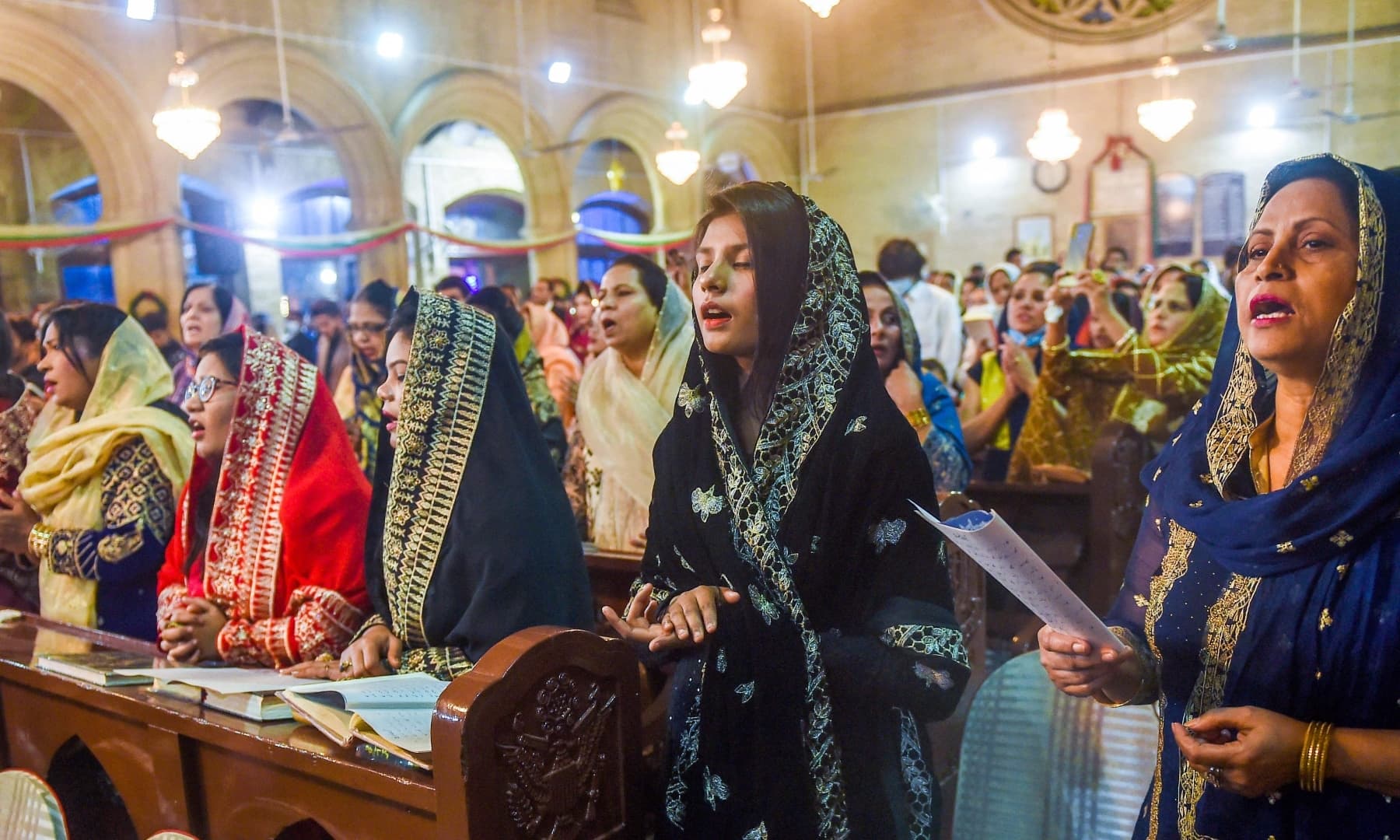
La Crosse, Wisconsin: September 22, 2009. On Sixteenth Sunday after Pentecost, September 20, 2009, at Christ Episcopal Church, La Crosse, Rev. Canon Patrick P. Augustine, D.Min., Rector, in his sermon said that I love Psalms. When I was a young boy I would go with my father early morning to worship at St. John's Church in Gojra, Pakistan (this is the city where Islamic militants in last August attacked hundreds of Christian homes. These were set on fire and 10 Christians were burnt alive in their homes). While growing up there we sang Psalms in Punjabi every morning. My father had learned all 150 psalms by heart and would recite them as part of his personal devotion. A few months back, before my mother died, I would visit her at lunch time to feed her. After lunch I would read a small passage from the Bible and sing one or two Psalms as she knew them by heart. I still like to sing psalms in Punjabi in early morning. When we study the teaching of Jesus we realize that Jesus quoted more often from Psalms and from the book of Prophet Isaiah than from any other book of the Old Testament. In the early Church, Psalms were incorporated in their worship.
Let me give you two examples from the Epistles about the use of Psalms:
1. Colossians 3: 16 Let the word of Christ dwell in you richly, teach
and admonish one another in all wisdom, and sing psalms and hymns and
spiritual songs with thankfulness in your hearts to God.
2. Ephesians 5:18-19 ---But be filled with the spirit, addressing one another in psalms and hymns and spiritual songs, singing and making melody to the Lord with all your heart.
Every Sunday when we sing the appointed psalm together we are making melody to the Lord with all our heart. Please do not remain silent next time we sing a Hyman or psalm as we raise our praises with thankfulness in our hearts to God. In Arabic when you ask somebody how are you. They answer back Alhamdulillah which means "Praise to God". This is similar to the Hebrew phrase, Alleluia, used by Muslims, Arabic speaking Jews and Christians.
Psalms are part of our Morning and Evening worship in the Book of Common
Prayer. This morning let us study the appointed Psalm 1.
Happy are they who have not walked in the counsel of the wicked,
nor lingered in the way of sinners,
not sat on the seats of the scornful.
Notice, here, the psalm opens with a benediction- happy, which is the Hebrew
word 'ashre' which can be translated blessed. In Greek the same word is makarikos which means happy or blessed. We realize it is the same way Jesus began his famous teaching of the Sermon on the Mount. It has been suggested that the original force of the word would be better captured in English by rendering it as "congratulations" "Congratulations to the pure in heart because they are going to see God!"[1] "Congratulations to those who have not walked in the counsel of the wicked."
Wicked, here, is not a reference to a criminal person such as a drug dealer, rapist or murder, but one who is ungodly with very little time for God in his life. This person is so busy that God has no place in the affairs and business of his or her life. There are those who have been trying for a long time in the West to take God from many spheres of our lives. By the end of the twentieth century the intelligentsia had little doubt that modern
man had outgrown God.--- The Economist was so confident of the Almighty's demise that they actually published His obituary in their millennium issue.[2] The Psalmist says the Godly man has a place in his heart for his Creator. The second verse makes it clear why the Godly man has rejected the way of the world and the way of the wicked.
Their delight is in the Law of the Lord,
And they meditate on his law day and night.
Each Sunday I ask you to take the bulletin home which has appointed lessons from the Holy Scripture to read and meditate for the rest of the Week. We
also have Day by Day which we offer to the congregation to use as your daily devotion. Reading Scripture helps us to have deep roots and understanding of our faith and Christian living. At the same time, meditating on the Law of the Lord does not mean that you are being asked to push everything aside and become ascetic or go around always thinking about scriptures and repeating them over and over all day long.
For example, I may greet you: "Good morning Dr. Miller, how are you?" Your answer may be "I am a tree planted by the streams of water, bearing fruit in due season, with leaves that do not wither." I am alright Rector, Alhamdulillah, praise be God." That is a mechanical kind of understanding of the Scripture and not the kind of religion Jesus expects us to live. Meditating on the word of God should take deep roots in our heart, soul and mind. It should start producing the fruits of the spirit such as love, kindness, gentleness which can be a blessing to us all. It should radiate from the life of the follower of Jesus Christ. It should help us to live our baptismal covenant to guard the dignity of all our fellow human beings to work for justice for the poor, work for shelter for the homeless or offer our prayers as healing hands of Jesus. The Law of the Lord dwells and radiates through the life of a godly person. Psalmist says, "Everything they do shall prosper".
It is not so with the wicked,
they are like chaff which the wind blows away.
Therefore, the wicked shall not stand upright when judgment comes,
nor sinners in the council of the righteous.
For the Lord knows the way of the righteous,
but the way of the wicked is doomed.
Many of our city folks may not understand chaff. In contrast to a tree, which represents deep rooted faith, chaff has no root, no fixed place. It is the dry covering of grain which, at the time of the harvest, will be separated and blown away. Just as the life of an ungodly person is attached to his or her material things which shall, at the end, all pass away. It is a hollow life at the end as it is attached to nothing. And that is God's evaluation of the life that has no room for God. It is worthless like chaff. Such a person may have all the toys and luxuries and be regarded as a big wheel. He or she has never fulfilled a single purpose for which God has intended in this world. This person's life is so much wasted time as far as God is concerned. Jesus said, "For what will it profit a man, if he gains the whole world and forfeits his life" (Matthew 16: 26).
Do you see the difference between the blessed man and the ungodly?
1. The ungodly are not blessed by God; they do not have delight in God's
Word, and they will not bear fruit by the Holy Spirit.
2. The Godly person, who is attached to and grounded in the person of
Christ, receives strength from the Word and the Sacrament. The life of the
person in Christ shall be a blessing to all who dwell on this earth and be
peaceable, gentle, willing to yield, full of mercy and bear good fruits of love, joy, peace, patience, kindness, goodness, faithfulness, gentleness and
self-control ( Gal. 5:22-23).
Let us claim this blessing as the Lord says, "Congratulation":
Happy are they who have not walked in the counsel of the wicked,
nor lingered in the way of sinners,
not sat on the seats of the scornful.
[1] Douglas R. A. Hare, Interpretation- Matthew, John Knox Press, 1993,
p.35.
[2] John Micklethwait and Adrian Wooldrige, God Is Back, The Penguin Press,
2009, p.12